

City-Number Cartography: Reading the Numerology of Urban Addresses
We often think of numerology as a map of our inner life: the path revealed by our birth date, the cadence of our name, the cycles that trace our personal seasons. Yet numbers are also stamped on the spaces we inhabit and the routes we move through—on doors and elevators, transit lines and postal codes, utility poles and crosswalk signs. What if the city itself is a mosaic of numerical atmospheres, and learning to read them helps you choose, tune, and harmonize your environment? This article proposes an original angle on numerology: a practice I call City-Number Cartography—the art of sensing the hidden rhythm of cities through the numerological signatures of addresses, neighborhoods, and daily routes.
Why place-numbers matter
Every location carries a sequence of numbers that repeatedly encounters your awareness: the apartment number you punch into a keypad, the floor digits lighting up as the elevator climbs, the postal code in your online forms, the bus number on your commute. In numerological terms, repeated exposure to a number is like being immersed in a frequency. A house at 1643, Unit 5, Floor 8 has a different “ambient chord” than a house at 27, Unit 9, Floor 2—even if they sit on the same block. Multiply that difference across a commute that shifts from Route 1 to Route 7, or a move from a 10012 postal code to 11216, and you start to see a living network of numerical qualities that either harmonize with you—or rub against your grain.
City-Number Cartography recognizes two scales of influence:
- Micro-codes: the most frequently contacted numbers—street number, unit/apartment number, floor, building entry code, parking space, mailbox number. These are personal and repetitive.
- Macro-codes: broader locational signatures—ZIP/postal code, area code, transit lines, district or ward numbers, highway exits. These form the environmental “weather.”
Neither scale is strictly deterministic. Instead, think of them as weather patterns and wardrobe choices. You do not control the rain, but a good coat changes your experience. If a macro-code brings intensity, your micro-codes can provide stability, and vice versa.
How to calculate a place’s number profile
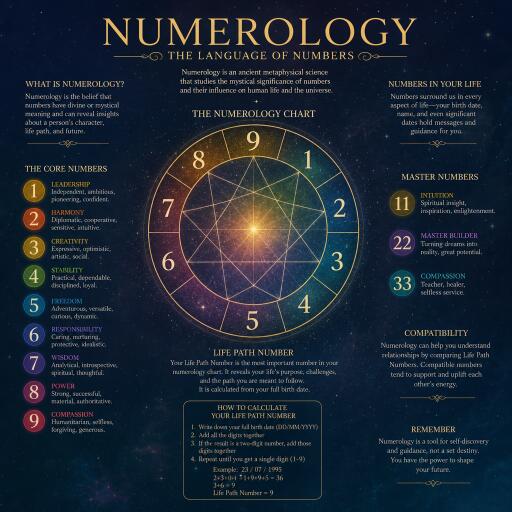
Classic numerology reduces numbers to their core vibrations (1 through 9), with master numbers (11, 22, and sometimes 33) optionally held intact. For City-Number Cartography, you can calculate both a single “Base Tone” and a small “Chord” for each place.
Step-by-step:
- Collect your place-numbers. For a residence: street number, apartment/unit, and floor. For workplace: suite, floor, building number. For macro context: postal/ZIP code and common transit line numbers you ride most often.
- Reduce each to a single digit unless you choose to keep master numbers intact. Example: 1643 → 1 + 6 + 4 + 3 = 14 → 1 + 4 = 5. Apartment 5 is already a 5. Floor 8 remains 8. ZIP 10012 → 1 + 0 + 0 + 1 + 2 = 4.
- Determine a Base Tone by combining the key micro-codes: street number + unit + floor. For the example: 5 (street) + 5 (unit) + 8 (floor) = 18 → 1 + 8 = 9. Base Tone = 9.
- Create a Chord by listing each reduced digit separately. In the example: micro-chord = [5, 5, 8]. Add macro-codes as a second line: postal 4, transit line 1 → macro-chord = [4, 1].
Interpreting the digits (a concise key):
- 1: Initiative, autonomy, leadership, starting new things.
- 2: Cooperation, sensitivity, diplomacy, partnership.
- 3: Expression, creativity, social flow, optimism.
- 4: Structure, order, discipline, foundations.
- 5: Change, freedom, movement, versatility.
- 6: Care, home, service, aesthetics, responsibility.
- 7: Reflection, research, inner work, quiet.
- 8: Power, results, finance, executive function.
- 9: Completion, humanitarianism, big-picture purpose.
- 11/22/33: Intensified themes—11 (insight/inspiration), 22 (master builder), 33 (compassion in action).
The Base Tone hints at the energetic “agenda” of the place in your life, while the Chord reveals textures that modulate that agenda throughout your days.
Aligning your personal numbers with a place
Most people start with their Life Path Number (derived from their birth date) to read compatibility. You can also factor in your Expression or Destiny Number (from your full name), but the Life Path gives a clear headline. Once you know your number, compare it to the Base Tone of a place and ask: does this place emphasize what I’m already living, or does it provide a healthy counterbalance?
General tendencies for pairings between your Life Path and a place’s Base Tone:
- Harmonizing pairs—feel like “home field advantage”:
- 1 with 1, 3, or 5: momentum, creativity, and experimentation.
- 2 with 2 or 6: partnership and supportive atmospheres.
- 3 with 1, 3, or 6: expression with comfort and encouragement.
- 4 with 4 or 8: structure meeting ambition.
- 5 with 1, 3, or 5: freedom within inspiration.
- 6 with 2, 3, or 6: nurturing plus social ease.
- 7 with 4 or 7: quiet focus and depth.
- 8 with 4 or 8: execution and advancement.
- 9 with 3 or 9: expansive, humanitarian flow.
- Stretch pairs—productive tension that can mature you:
- 1 with 2 or 4: learning patience and process.
- 2 with 1 or 5: developing initiative and adaptability.
- 3 with 4 or 7: honing discipline and depth.
- 4 with 3 or 5: inviting flexibility and play.
- 5 with 4 or 8: tempering impulse with structure.
- 6 with 1 or 8: balancing caretaking with leadership.
- 7 with 3 or 8: engaging expression and real-world goals.
- 8 with 2 or 9: softening power through empathy and purpose.
- 9 with 1 or 4: turning vision into practical starts and systems.
There is no “wrong” address; there are only different lessons and supports. If your Life Path 7 lands in a Base Tone 3 home, expect more social invitations and expressive projects. If that’s too noisy, you can “tune” the space (see below) to add 4 or 7 vibrations for quiet and focus.
Decoding your commute and daily routes
Your commute can act like a metronome, setting the rhythm for your day. To read its numerology:
- List the identifiers you encounter repeatedly: bus or train line numbers, transfer platform numbers, exit numbers, average departure time, even the number of stops.
- Reduce each number and then create a simple “sequence string.” Example: Line 2 → 2; Transfer at Platform 11 → 11 or 2; Exit 7 → 7; 8 stops → 8. Sequence: 2-11-7-8.
- Read it narratively. In this example, a day that begins with cooperation (2) is sparked by insight (11), dives into reflection (7), and aims for results (8). If that matches your agenda, great. If not, experiment: try leaving at 6:45 (6 + 4 + 5 = 15 → 6) instead of 7:20 (7 + 2 + 0 = 9) for a week and journal the differences in tone and productivity.
This is not a call to micromanage your schedule by digits, but a sensitivity practice. Over time, you will notice which route numbers get you “in gear” for certain tasks, and which ones soothe you after demanding days.
Tuning a place: subtle numerical remedies
Sometimes you cannot change your address, unit, or route—and you don’t have to. You can introduce or emphasize complementary vibrations through small, meaningful tweaks:
- Label adjustments: If your unit is a strong 5 (change, stimulation) but you need more 4 (structure), consider adding a discreet letter or nameplate element whose alphanumeric value supports a 4. Many alphabet systems assign A=1, B=2, etc.; using D (4) or a nameplate including a 4-vibe word can be symbolically effective.
- Grouping objects: Curate clusters by number. Four sturdy wooden items on your desk invite 4 energy. Three colorful accents in the living room call in 3 expression.
- Color and material pairings: While color symbolism varies by tradition, you might pair:
- 1 with crisp lines and bold accents to signal initiative.
- 2 with soft textures and pairs of objects for harmony.
- 3 with vibrant art and playful shapes for joy.
- 4 with earth tones and square forms for stability.
- 5 with mixed patterns and mobile elements for movement.
- 6 with warm lighting and balanced symmetry for comfort.
- 7 with minimalism and reflective surfaces for contemplation.
- 8 with metallics and solid furniture for authority.
- 9 with global motifs and open layouts for universality.
- Entrance rituals: The threshold sets the tone. Count nine steady breaths before unlocking the door to activate completion and release. Or ascend stairs in groups of four to infuse order before work.
These gestures are not superstitions so much as cues to your nervous system, aligning external signals with internal intentions.
Fieldwork: map your city-number ecosystem
To make this practice concrete, try a 21-day exploration:
- Profile your current home and workplace using the Base Tone and Chord method. Note how the micro- and macro-codes feel during your typical week.
- Create two alternate commute options and calculate their sequences. Try each for one week (or split days) and observe your mood, focus, and social interactions.
- Adjust one environmental factor each week using tuning methods (labels, object groupings, color/material cues). Choose a target number that supports your goals.
- Journal with numerological prompts:
- Which digits did I “see” most today? How did their qualities show up in events and choices?
- What changed when I shifted a route time or added a number-coded object grouping?
- Did my space feel like it was amplifying me (harmonizing) or educating me (stretching)?
- At the end, synthesize. Which combinations of place-numbers and daily sequences best support your current season (launching, stabilizing, healing, expanding)?
Neighborhood archetypes and postal chords
While each block has its own flavor, postal or ZIP codes often hint at neighborhood-wide tendencies. A ZIP reducing to 3 may correlate with lively cafés, events, and street art—great for projects needing exposure. A 7-leaning area may host libraries, small research labs, or quiet green spaces—ideal for study or inner work. An 8-tone district might cluster financial firms and serious architecture, helping you put your ambitions into motion. None of these are absolutes; they are lenses for noticing and choosing. If your work needs intensity (8) but you live in a gentle 6 zone, perhaps find a co-working spot whose suite and floor add up to 8, and commute there three days a week. You’re not trapped by a single code; you can curate your own constellation of supportive places.
When numbers conflict—and how to listen
Sometimes you’ll encounter sharp dissonances: you move to a 2 Base Tone home for partnership, but your bus line is a restless 5 and your workplace a commanding 8. Across the week, you may feel torn between tending the relationship, chasing novelty, and meeting high-stakes goals. Rather than force harmony, let the dissonance educate your timing:
- Batch by number. Reserve 8-ish tasks (budgets, negotiations) for days when your route or schedule leans toward 8. Keep 2-ish tasks (check-ins, counseling) for evenings you return via a 2 line or after a 2-coded ritual.
- Use thresholds as switches. Before leaving a 2 home for an 8 office, pause at the door and count to 8 while setting a clear intention. On returning, count to 2 and soften the body.
- Introduce counterweights. If the workplace is intensely 8, add a 3-coded lunch routine—perhaps a café at address 12 (3) with a friend—to keep joy in the mix.
Ethics, realism, and magic
City-Number Cartography is a creative, reflective practice, not a guarantee machine. It doesn’t replace practical considerations like budget, commute length, accessibility, or safety. Consider it a way to refine choices you’re already making, or to bring consciousness to patterns you feel but haven’t named. The “magic” here is participatory: attention changes experience. When you start to notice that a certain bus line reliably makes you feel scattered, you can try a different line, time, or ritual. When you notice that a 4 Base Tone office lets you finally finish your manuscript, you can choose to spend your toughest drafting days there.
Equally, beware of outsourcing agency to the numbers. A 5 address doesn’t force chaos any more than a 4 address guarantees productivity. Your intentions, behaviors, and relationships co-create the outcome. Numbers are allies, not rulers.
Putting it all together
Think of your city as a symphony and yourself as both the listener and the composer. Your home has a key signature, your workplace another. Your commute is the tempo between them. On certain days, you might introduce a counter-melody (a different café, a side street, a detour through a park) to shift the mood. On others, you play the main theme louder by amplifying the place’s Base Tone with supportive cues. Over weeks and months, you’ll discover which combinations bring out your best work, your best care, your best rest.
If numerology has helped you understand yourself from the inside out, City-Number Cartography invites you to read the world from the outside in—and then meet it halfway. Count what counts around you. Curate it with intention. And let the hidden rhythm of your city become an instrument you know how to play.