

Chrono-Numerology: Designing Your Time and Habits Around Number Cycles
What if you could overlay a simple, soulful framework on your calendar that not only keeps you organized but also amplifies your creative timing and energy? Chrono-numerology is an original approach that blends the archetypal meaning of numbers with practical time-blocking. Instead of using numerology only to interpret personalities or destinies, we apply the 1–9 cycle directly to days, weeks, projects, and even communication windows—turning numbers into a compass for modern life.
Why time plus numbers?
Traditional time management assumes uniform energy and linear progress. Real life doesn’t work that way. Energy ebbs, projects move in arcs, and breakthroughs often arrive after coherent build-up. Numerology’s nine archetypes offer a simple language for these arcs. By mapping the 1–9 energies onto your days and routines, you create a rhythm that naturally supports initiation, iteration, refinement, connection, consolidation, and release.
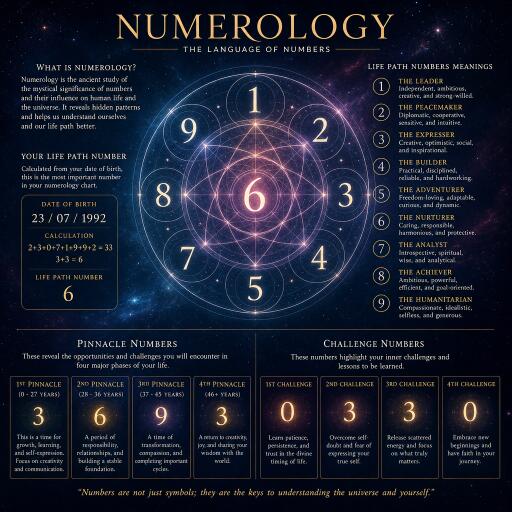
The nine archetypes at a glance
- 1 – Spark: Begin, assert, decide, plant the flag.
- 2 – Bridge: Listen, collaborate, negotiate, take small steps.
- 3 – Express: Write, market, brainstorm, prototype.
- 4 – Build: Structure, systems, checklists, patient craft.
- 5 – Pivot: Experiment, travel, meet new people, adapt.
- 6 – Steward: Care, refine, harmonize teams and home.
- 7 – Study: Research, analyze, step back for insight.
- 8 – Execute: Lead, negotiate contracts, budgets, outcomes.
- 9 – Culminate: Finish, publish, donate, release, transition.
Step 1: Find your anchor number
Your anchor helps personalize the cycle. You can use one or both:
- Life Path: Sum your birth date digits to a single digit (acknowledging master numbers 11, 22, or 33 if they appear before the final reduction). Example: 1990-07-24 → 1+9+9+0+0+7+2+4 = 32 → 3+2 = 5.
- Current Personal Year: Sum your birth month and day with the current calendar year, reducing to a single digit (again honoring master numbers before final reduction if you prefer). Example: Birth 07/24 and year 2026 → 0+7+2+4+2+0+2+6 = 23 → 2+3 = 5.
Interpretation: a Life Path 5 thrives on adaptability; in a Personal Year 5, you may prioritize exploration and revitalization. These anchors help you decide which phases to emphasize or soften in your cycles.
Step 2: The 9-phase day
Instead of using the same work pattern every day, break your waking hours into nine phases. They don’t have to be equal in length—but aim for a cadence you can repeat. For example, during a 15-hour waking day, you might use nine 75–90 minute segments with short resets between them.
Assign the archetypes 1 through 9 to each successive phase:
- Phase 1 (1): Set one bold intention; pick the day’s keystone task.
- Phase 2 (2): Quick check-ins, coordinate, remove interpersonal friction.
- Phase 3 (3): Draft content, whiteboard, ideate, memo writing.
- Phase 4 (4): Deep build—code, edit, assemble, organize.
- Phase 5 (5): Break routine—walk, new input, call, demo.
- Phase 6 (6): Quality pass—polish, fix bugs, resolve support tickets.
- Phase 7 (7): Research—read, analyze data, reflect away from screens.
- Phase 8 (8): Execute—decisions, negotiations, budget approvals.
- Phase 9 (9): closure—publish, send, archive, prepare smooth handoff.
Tip: If your anchor is 4 (systems) and you need more stability, elongate Phase 4 and 6 blocks. If your anchor is 3 (expression), stretch Phase 3 and 9 to prioritize creation and release.
Step 3: The 9-day micro-cycle
Extend the same arc across nine days. Each day adopts one number’s energy. You can start your cycle on any date—some prefer a Monday or a new moon; others sync to personal day numbers. Here’s a traditional way to compute personal timing if you want astrological precision without complexity:
- Personal Year (PY): Birth month + birth day + current year → reduce to a digit (respecting master numbers if you wish).
- Personal Month (PM): PY + calendar month number → reduce.
- Personal Day (PD): PM + calendar day → reduce.
Use PD to identify where you are in the 1–9 arc on any date. If your PD is 7 today, emphasize research and reflection. Tomorrow’s PD is 8, so plan to make proposals or finalize logistics then.
Example flow for a 9-day arc:
- Day 1: Kick off one definitive project goal; avoid multitasking.
- Day 2: Collect requirements, host alignment meetings.
- Day 3: Draft copy, mockups, outreach templates.
- Day 4: Build infrastructure, repository cleanup, documentation.
- Day 5: User interviews, experiments, field tests.
- Day 6: QA, team care, customer care, HR follow-ups.
- Day 7: Metrics review, root-cause analysis, learning time.
- Day 8: Close deals, budget allocations, strategic decisions.
- Day 9: Publish, deliver, celebrate, retire what’s complete.
Step 4: Meso-cycles for projects
Projects breathe in larger arcs. Try:
- 27-day arcs (3×9): Wave 1 discovery, Wave 2 build, Wave 3 polish-launch.
- 81-day sprints (9×9): For substantial initiatives; track each 9-day as a chapter.
Map milestones to 1, 4, 7, and 9 days for a satisfying cadence: start (1), structural checkpoint (4), insight checkpoint (7), culmination (9).
Assigning work by number
Use this quick mapping when planning your week:
- Hiring and HR thrive on 2 (fit), 6 (care), and 8 (offers/comp).
- Marketing and media favor 3 (creative) and 9 (publish).
- Engineering and ops thrive on 4 (build), 6 (stability), and 7 (R&D).
- Sales and finance shine on 8 (negotiation) and 1 (prospecting).
- Exploration, travel, or testing pairs with 5.
Personal energy tuning
Let your anchor number modulate your cycle:
- Life Path 1: Protect morning Phase 1 and Day 1; make one hard decision early.
- Life Path 2: Lean into Day 2 and 6 for relationship work; schedule “bridge” time after intense sessions.
- Life Path 3: Stack expressive tasks on 3 and 9; implement a daily “publish or ship something small” ritual.
- Life Path 4: Give your 4-phase longer blocks. Weekly “system Saturday” (4-day) deep clean.
- Life Path 5: Install novelty on 5; intentionally rotate environments to avoid stagnation.
- Life Path 6: Use 6 for harmonizing team/home; schedule check-ins and care tasks then.
- Life Path 7: Reserve distraction-free research windows on 7; protect them fiercely.
- Life Path 8: Align major asks, proposals, and executive meetings on 8.
- Life Path 9: Practice conscious closure on 9—donate, archive, forgive, and move.
Analog rituals that make it stick
- One-card compass: Keep an index card with today’s number at your desk. Write one verb that matches (e.g., “Consolidate” for 6).
- Color-coding: Assign colors to numbers in your calendar (e.g., 1 red, 2 silver, 3 yellow, 4 green, 5 turquoise, 6 rose, 7 indigo, 8 black, 9 gold). The visual cue nudges behavior.
- Micro-closings: At the end of each 9-phase day, perform a 90-second “9 ritual”: close tabs, log wins, set one release for tomorrow.
- Seed minutes: Begin 1-days with a single 9-minute starter task to overcome inertia.
Digital templates to operationalize
- Calendar: Create nine recurring daily labels (1–9) across the week; let meeting types drift to their native numbers.
- Tasks: Prefix tasks with their ideal number (e.g., “(4) Refactor billing module”). Batch accordingly.
- Notes: A single rolling document with sections 1–9; each day, add bullet points under the active number.
Sample day plan
Suppose it’s a Personal Day 3 for you. You might arrange your day as:
- Phase 1 (1): Decide the message you want the world to hear today.
- Phase 2 (2): Align with colleagues; gather talking points.
- Phase 3 (3): Draft the blog or campaign assets.
- Phase 4 (4): Load assets into the CMS; set structure and tags.
- Phase 5 (5): Test a new channel or CTA variation.
- Phase 6 (6): QA links, images, accessibility checks.
- Phase 7 (7): Review analytics from prior posts; learn and tweak.
- Phase 8 (8): Final approvals and go/no-go decision.
- Phase 9 (9): Publish, then archive assets and notes.
Common pitfalls (and how to avoid them)
- Over-precision: Don’t turn this into numerological micromanagement. Use it as a guide, not a cage.
- Skipping rest: 7 isn’t optional; it protects quality. Pair 7 with screen-free reflection or slow learning.
- Ignoring reality: If a deadline lands on a 2-day, do the work anyway—soften the edges with a brief check-in first.
- Forgetting closure: The gains arrive at 9. Celebrate to lock in momentum and make space for the next 1.
Advanced layering (for enthusiasts)
If you enjoy more nuance:
- Dual keys: Overlay the Universal Day (sum of the calendar date) with your Personal Day. If Universal is 8 and Personal is 3, enhance expressive work with decisive distribution (e.g., pitch the draft to a high-stakes outlet).
- Master numbers: If 11, 22, or 33 appear in your calculations before reduction, you may treat them as heightened versions of 2, 4, and 6 respectively—emphasizing intuition (11), architecture (22), or healing/service (33) on those days.
- Seasonal resets: Begin a fresh 9×9 arc at equinoxes/solstices; review what your 1s initiated and your 9s completed in the prior season.
Quick-start checklist
- Calculate your Life Path and Personal Year for an anchor.
- Adopt a 9-phase template for your day (even if only 5 of the 9 are used at first).
- Label each calendar day 1–9 for the next two weeks.
- Batch work: draft on 3, build on 4, research on 7, decide on 8, ship on 9.
- End each 9 with a closure ritual and one gratitude note.
Numbers are not rules—they are rhythms. Sync with the rhythm, and effort stops feeling like friction.
What changes when you live by cycles
Two subtle shifts usually show up quickly. First, your decision fatigue drops: the “what should I do now?” question is replaced by a daily verb. Second, your momentum compounds because you’re not forcing a 9 when the day is clearly a 4, or trying to build systems in the middle of a 5. Over weeks, this coherence feels like calm productivity—a quiet confidence that the right work is happening at the right time.
Chrono-numerology doesn’t promise miracles; it offers language. When your calendar speaks that language—spark, bridge, express, build, pivot, steward, study, execute, culminate—you’ll notice that your days feel designed rather than improvised. And that feeling often precedes the very outcomes we keep chasing: meaningful progress, generous endings, and the courage to begin again.