

The 27-Day Numerology Loop: A Micro-Cycle Method for Creative Focus and Renewal
Most numerology frameworks focus on life-long arcs and annual currents, but creative momentum is built in the small windows of time where attention, meaning, and energy align. This article introduces an original, practical approach: the 27-Day Numerology Loop. It’s a three-week-plus rhythm built on the numerological significance of 9 (completion) and 3 (creation), designed to structure your efforts into a repeatable cycle that renews focus, honors rest, and compounds gains.
Why 27? The Numerological Rationale
In numerology, 9 represents culmination, wisdom, and integrative power—it gathers all numbers that come before it. The number 3 symbolizes creation, expression, and catalytic growth. Multiply them (3 × 9) and you get 27: a compact season for a goal to germinate, bloom, and ripen. Reduced, 2 + 7 = 9, so each 27-day loop ends in completion and renewal. The loop is short enough to sustain momentum but long enough to see meaningful change.
Think of 27 days as a micro-season. You plant on Day 1, cultivate across 2–8 with distinct thematic energies, and harvest-reflect on Day 9. Then you repeat the nine-beat pattern two more times, each pass deepening the work. By Day 27, you’ve completed three crescendos and distilled insights you can carry into the next loop.
The Structure: Three Nines, Nine Beats
Each 27-day loop consists of three nine-day phases. Within each nine-day phase, you move through the micro-energies of 1 through 9. The beats remain constant; the intensity and sophistication of your tasks grow with each phase.
The Nine Micro-Energies (Daily Themes)
- 1 — Initiate: Start clean. Define one clear outcome. Commit publicly (even if only to a journal). Take the first decisive action.
- 2 — Align: Partner and harmonize. Share your plan with a collaborator, mentor, or friend. Adjust based on feedback or your own intuition.
- 3 — Create: Generate material. Draft, prototype, brainstorm, or perform. Prioritize quantity over polish.
- 4 — Build: Systems and structure. Choose tools, set constraints, block time, and lock in process.
- 5 — Expand: Experiment and circulate. Test variations. Add novelty. If relevant, publish or share a sample.
- 6 — Care: Integrate support and stewardship. Tend to quality, relationships, and environment. Fix friction.
- 7 — Reflect: Step back. Review metrics, patterns, and energy levels. Meditate, study, and refine your approach.
- 8 — Execute: Power forward. Ship, present, or monetize. Assert boundaries. Make consequential moves.
- 9 — Complete: Conclude a mini-arc. Release what’s done, archive what’s not, and ritualize closure. Distill lessons.
Across Days 1–9 you run Version 1 of the cycle; Days 10–18 replay the nine beats as Version 2 (deeper, bolder); Days 19–27 as Version 3 (refined, culminating). The beauty is in the repetition: it creates a groove the mind and body remember.
Before You Start: Calibrating to Your Numbers
While anyone can use the loop, you can personalize it with a few numerological anchors:
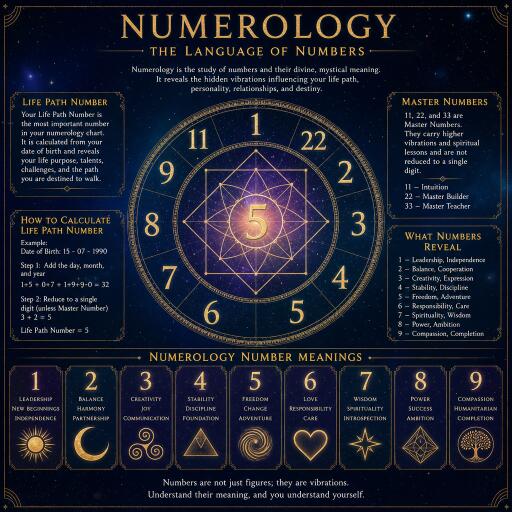
- Life Path Number: Sum your full birth date to a single digit (acknowledging master numbers 11, 22, 33 if they appear). This is your core operating frequency.
- Personal Year: Add your birth month + birth day + the current year, then reduce to a single digit (or master). This sets the year’s overarching tone.
- Personal Month/Day: Add the Personal Year to the calendar month to find the Personal Month; add that to the calendar day for the Personal Day, reducing as needed. Aligning your loop start near a Personal Day 1 can feel like catching a favorable wind—but it’s not required.
Translate these insights into practice: if your Life Path is 7 (introspective), infuse more study and solitude on 7, 4, and 9 days. If your Personal Year is 5 (change), privilege flexible experiments on 5 and 8 days.
How to Build Your 27-Day Loop
- Choose a single theme for the loop. Examples: “Draft a 20-page proposal,” “Rebuild my morning routine,” “Launch a podcast pilot.” Keep it focused and measurable.
- Define “success fragments.” Break success into three milestones, one for each nine-day phase (Version 1, 2, 3). Each should be achievable in nine days.
- Pick your start date. If you enjoy alignment, begin on a calendar day that reduces to 1 or that matches your Life Path. Otherwise, start Monday, tomorrow, or the next new moon—momentum matters more than math.
- Map the nine beats to your theme. For each beat (1–9), pre-decide specific actions that match the energy. This prevents decision fatigue.
- Set rituals and safeguards. Lightweight daily ritual (2–5 minutes) to anchor the day’s energy; pre-commit small consequences or rewards to sustain follow-through.
- Track two metrics: one output (pages written, sessions completed) and one wellness (sleep hours, stress rating). Numerology honors balance.
Two Sample 27-Day Loops
Example A: Life Path 3 (The Creator) — Write and Publish a Three-Part Essay
Milestones: V1 (Days 1–9): rough drafts of three essays. V2 (10–18): revised drafts + two peer reviews. V3 (19–27): final edits + published posts.
- 1 — Start a master outline; free-write opening paragraphs.
- 2 — Share outline with a trusted friend; integrate one note.
- 3 — Draft Essay 1 without self-editing.
- 4 — Create a template for intros, subheads, and conclusions; block daily 90-minute writing slots.
- 5 — Draft Essay 2; try a new rhetorical device or story.
- 6 — Tidy your workspace; refine tone for audience care; batch citations.
- 7 — Read your drafts aloud; highlight patterns to improve.
- 8 — Draft Essay 3; schedule publishing dates; pitch one newsletter cross-post.
- 9 — Compile V1; note three lessons; archive scraps.
Repeat the pattern for V2 and V3 with deeper intensity (e.g., on V2’s 8-day, send to two editors; on V3’s 8-day, publish and promote). Day 27: celebrate completion with a release ritual and a metrics review.
Example B: Life Path 8 (The Builder) — Validate and Pre-Sell a Workshop
Milestones: V1: workshop outline + landing page draft. V2: beta session + testimonials. V3: paid launch.
- 1 — Define the workshop outcome and one-liner.
- 2 — Interview two ideal participants; refine promise.
- 3 — Draft slides skeleton; record a 2-minute teaser.
- 4 — Set up a simple CRM or spreadsheet; plan outreach cadence.
- 5 — Post teaser to one platform; test two headlines.
- 6 — Follow up with warm contacts; clarify pricing and policies.
- 7 — Review data: views, clicks, replies. Adjust angle.
- 8 — Host a mini Q&A; invite pre-registrations.
- 9 — Close V1: decide on the beta date and scope.
In V2, run the beta, collect testimonials, and tighten delivery. In V3, scale: formal launch, partnerships, and a confident close on Day 27.
Adapting the Loop to Your Life Path
- 1 — Pioneer: Keep Day 1 bold. Use Day 4 to protect your calendar. On Day 7, intentionally pause to avoid burnout.
- 2 — Diplomat: Double down on Days 2 and 6 for collaboration and care. On Day 8, practice assertiveness with clear asks.
- 3 — Creator: Maximize Days 3 and 5 for ideation and play. Use Day 4 templates to corral overflow creativity.
- 4 — Builder: Treat Days 4 and 8 as peak work. On 5, invite one controlled experiment to prevent rigidity.
- 5 — Explorer: Use Days 5 and 8 to push edges; put gentle rails on 1 and 4 to stay oriented.
- 6 — Steward: Emphasize Days 6 and 2 for quality and community. On 9, complete and release—don’t over-caretake.
- 7 — Seeker: Make Day 7 sacred for study. Use Day 3 to create from insight, not just analysis.
- 8 — Executive: Anchor Day 8 as your signature move. Remember Day 2 relationships and Day 6 integrity.
- 9 — Sage: Let Day 9 be generous release. On Day 1, start small to avoid grand but vague intentions.
- 11/2 — Visionary: On Days 2 and 7, protect sensitivity with quiet space. Translate vision on Day 3 into tangible drafts.
- 22/4 — Master Builder: Use Day 4 for architecture and Day 8 for execution. Share the vision on Day 5 to galvanize allies.
- 33/6 — Master Teacher: Days 3 and 6 are for expressive care. On Day 9, release teachings without perfectionism.
Rituals That Supercharge the Cycle
- Morning cue: Speak the day’s number and theme aloud. Example: “Five: Expand—today I test and share.”
- Micro-token: Keep a small object (stone, coin, card) marked 1–9 and rotate it daily as a physical anchor.
- Numerical soundtrack: Create nine playlists or soundscapes that match each energy.
- Closing breath: End each day with one sentence of gratitude and one intention for tomorrow’s number.
Reflection and Review
On each Day 9 (i.e., Days 9, 18, 27), perform a short review:
- What completed? Name one concrete deliverable or closure.
- What resisted? Note a friction pattern by number (e.g., 4-days felt heavy—maybe simplify structure next time).
- What will I change? Adjust the mapping for the next nine-day pass.
On Day 27, close the loop with a simple ritual: archive, celebrate, and choose one lesson to carry forward. If you’re starting a fresh 27-day cycle, let the final insight seed Day 1’s initiation.
Common Pitfalls (and How to Avoid Them)
- Over-engineering: The loop is a rhythm, not a prison. If you miss a day, continue the sequence; don’t restart unless momentum truly collapsed.
- Ignoring energy reality: If Days 7 and 2 feel low-power, design them as lighter by intention. Reserve heavy lifts for 4 and 8.
- Outcome sprawl: One loop, one theme. Park extra ideas in a “next loop” list.
- Silent metrics: Without simple tracking, progress hides. Two numbers daily are enough.
- Perfection on Day 9: Completion means appropriate closure, not eternal polish. Release and learn.
FAQ
Can I run multiple loops at once? You can, but results dilute. If necessary, stagger themes so their heavy days (4, 8) don’t collide.
Do I need to calculate Personal Days? No. Alignment helps some people feel synced, but the discipline is what compounds.
What if a crisis interrupts the loop? Resume at the next numbered energy, or—as a compassionate reset—pick a fresh Day 1 with a small win.
Is there a best time of year? A Personal Year 1 or 3 often feels generative, but any season can hold a focused micro-season of growth.
Closing Thought
The 27-Day Numerology Loop is a creative pact with time. It doesn’t predict outcomes; it provides a cadence that helps you make them. Run one cycle to learn the rhythm. Run three to witness transformation. Let numbers be your metronome, not your master—and see what becomes possible when intention meets a steady, meaningful beat.