

The Numerology of Thresholds: Finding the Hidden Number Between Life Chapters
Traditional numerology often focuses on fixed elements: a birth date, a name, a home address, or a recurring number. Yet many of life’s most meaningful moments are not fixed at all. They are thresholds—the periods between leaving one identity and fully entering another. Moving to a new city, changing careers, beginning a relationship, completing a degree, or returning to ordinary life after a major loss can all create this sense of standing between two worlds.
Threshold numerology offers a symbolic way to explore these transitional periods. Instead of asking, “What number am I?” it asks, “What number connects where I have been with where I am going?” The result can be called a Bridge Number: a temporary numerical theme that helps frame the opportunities, tensions, and lessons of a particular transition.
Like other forms of numerology, this practice is not a scientific method or a tool for predicting certain outcomes. Its value lies in reflection. Numbers become prompts through which we can examine change from a fresh perspective, notice emotional patterns, and make our intentions more explicit.
Why Thresholds Deserve Their Own Number
Major transitions rarely happen in a single instant. A resignation may be submitted on one day, but the psychological departure began months earlier. A wedding has an official date, but the shift from independent life to partnership unfolds before and after the ceremony. Even moving house includes several identities: the person preparing to leave, the person in transit, and the person learning to belong somewhere new.
This ambiguity can be uncomfortable because people naturally prefer clear categories. Numerology traditionally reduces complex dates to simple digits, giving them a compact symbolic form. Threshold numerology uses the same principle but preserves the idea of movement by working with two dates: the date associated with departure and the date associated with arrival.
The Bridge Number does not label the entire future. It represents the connective passage itself—the qualities that may help someone travel from one chapter into the next.
How to Calculate a Bridge Number
Begin by choosing two dates:
- The departure date: the day the old chapter formally or emotionally ended.
- The arrival date: the day the new chapter began or is expected to begin.
Reduce each date by adding all of its digits until you reach a single number. Many numerologists preserve 11, 22, and 33 as “master numbers,” but for this particular method it is simpler to reduce every result to a digit from 1 to 9.
Imagine that someone leaves a long-term job on March 14, 2026:
3 + 1 + 4 + 2 + 0 + 2 + 6 = 18
1 + 8 = 9
The departure date is therefore associated with 9.
They begin a new business on June 8, 2026:
6 + 8 + 2 + 0 + 2 + 6 = 24
2 + 4 = 6
The arrival date is associated with 6. To calculate the Bridge Number, add the two reduced numbers:
9 + 6 = 15
1 + 5 = 6
The Bridge Number for this transition is 6. Symbolically, that suggests the passage may revolve around responsibility, service, balance, and the creation of a stable environment. For a person starting a business, it might prompt useful questions: Who will the work serve? How can ambition coexist with personal wellbeing? What kind of community should form around the new venture?
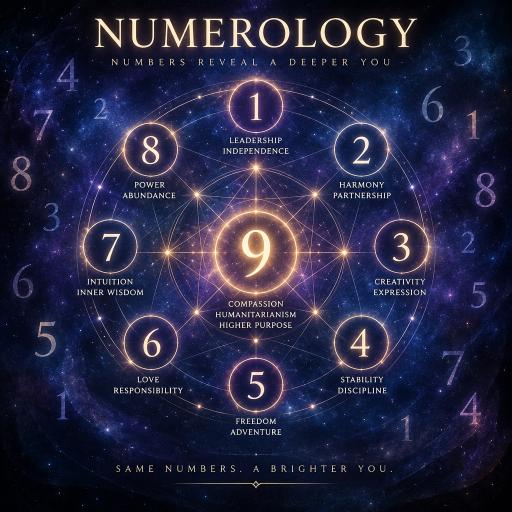
The Meanings of the Nine Bridge Numbers
Bridge Number 1: The Passage of Independence
A 1 threshold emphasizes initiative, courage, and self-definition. The transition may require a person to act without waiting for complete approval or certainty. Its challenge is isolation: independence can become defensiveness if help is rejected automatically. This number invites a clear first step and a willingness to claim authorship of the new chapter.
Bridge Number 2: The Passage of Cooperation
The number 2 highlights patience, partnership, and sensitivity. Progress may depend less on force and more on timing, listening, and negotiation. During this transition, relationships can act as mirrors. The central question is not merely “What do I want?” but “How can different needs exist together?”
Bridge Number 3: The Passage of Expression
A 3 bridge suggests that communication is essential. The person may need to tell their story, reconnect with creativity, or replace an outdated narrative about the past. Writing, conversation, visual art, and humor can all help the transition move forward. The risk is scattering energy across too many possibilities without completing any of them.
Bridge Number 4: The Passage of Structure
Number 4 brings attention to foundations, routines, and practical details. A new chapter may succeed only when supported by schedules, budgets, boundaries, or repeatable habits. This bridge can feel slow, but its symbolic lesson is that stability is built rather than discovered. Flexibility remains important so that structure does not harden into resistance.
Bridge Number 5: The Passage of Freedom
A 5 transition is associated with movement, experimentation, and changing conditions. It often suits journeys in which the final destination cannot yet be fully defined. Curiosity is an asset here. However, freedom should not be confused with constant escape. The number asks which changes create genuine growth and which merely postpone commitment.
Bridge Number 6: The Passage of Responsibility
Number 6 focuses on care, belonging, and sustainable responsibility. Home and family themes may become especially visible, even when the transition concerns work. The lesson is to create harmony without assuming responsibility for everyone’s happiness. Healthy service includes boundaries and care for the self.
Bridge Number 7: The Passage of Understanding
A 7 bridge favors introspection, study, and the search for deeper meaning. The visible pace of change may slow while internal understanding develops. Solitude can be restorative, provided it does not become complete withdrawal. Research, meditation, therapy, or spiritual practice may offer useful ways to examine what the transition is revealing.
Bridge Number 8: The Passage of Power
The number 8 raises questions about authority, resources, achievement, and influence. Financial or professional issues may be prominent, but the deeper theme concerns the use of power. Does the new chapter create mutual value, or does success come at an unacceptable cost? This bridge encourages ambition guided by accountability.
Bridge Number 9: The Passage of Release
A 9 bridge is connected with completion, compassion, and letting go. It suggests that something must be honored and released before the next phase can be fully inhabited. This does not require forgetting the past. Instead, the transition involves carrying forward its wisdom without continuing to live inside its unfinished emotions.
Adding a Personal Anchor Number
The method can be made more personal by including an Anchor Number derived from a meaningful word. Choose one quality you want to preserve during the transition, such as “calm,” “trust,” or “courage.” Using the common Pythagorean system, assign letters the numbers 1 through 9 repeatedly: A is 1, B is 2, and so on, with J returning to 1.
For example, “CALM” becomes C = 3, A = 1, L = 3, and M = 4. The total is 11, which reduces to 2. This Anchor Number does not change the Bridge Number. Instead, it represents the quality a person can consciously bring into the passage. A Bridge Number of 5 paired with an Anchor Number of 2 could be interpreted as freedom guided by cooperation and emotional awareness.
Questions for a Threshold Numerology Journal
Once the numbers have been calculated, reflection matters more than memorizing definitions. Consider writing about the following questions:
- What am I truly leaving behind: a place, a role, a habit, or a version of myself?
- Which quality of my Bridge Number already appears in this transition?
- What is the constructive expression of this number?
- What might its unbalanced expression look like?
- How can my Anchor Number become a practical daily action?
- What would it mean to cross this threshold intentionally rather than reactively?
A Symbolic Map, Not a Command
Threshold numerology is most useful when treated as a language of metaphor. A number should not determine whether someone accepts a job, ends a relationship, makes an investment, or seeks medical care. Important choices require evidence, honest communication, professional guidance where appropriate, and attention to real-world consequences.
What a Bridge Number can offer is a memorable theme. It condenses the emotional complexity of transition into a symbol that can be revisited when the path feels unclear. Life chapters do not always close neatly, and new beginnings seldom arrive without traces of the past. The threshold between them is not empty space. It is a chapter of its own—and numerology provides one imaginative way to read it.