

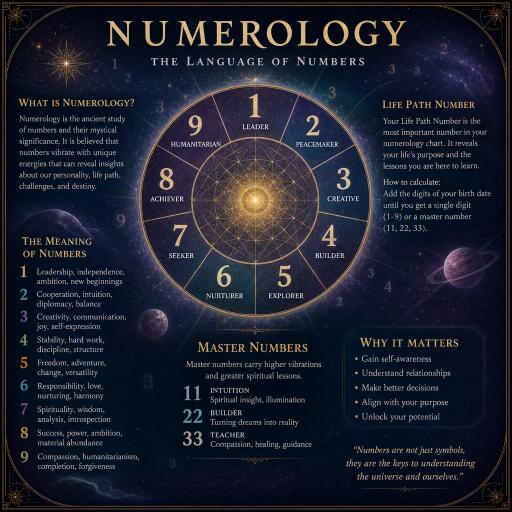
Pattern Density Numerology: A Fresh Lens for Reading the Repeats, Gaps, and Sequences in Your Numbers
Most numerology focuses on reducing numbers to their core digits (1–9) and interpreting the resulting Life Path, Destiny, or Soul Urge. While those pillars are useful, they often overlook the music between the notes—the way digits repeat, cluster, vanish, and arrange themselves in a sequence. This article introduces a new, original approach I call Pattern Density Numerology (PDN): a way to read not just what your numbers are, but how they behave together. Think of it as textural numerology, where the texture—dense or airy, repeating or varied, directional or reflective—adds dimension to your interpretation.
Why a new lens?
Traditional numerology excels at offering archetypal meanings to core numbers. But if three people all share a Life Path 7, their actual digit patterns can be strikingly different: one might have many repeats (focused intensity), another might have high variety (adaptability), and a third might carry a conspicuous absence of certain digits (growth edges). PDN illuminates these differences by analyzing four things:
- Digit Diversity: How many different digits show up?
- Dominance: Which digit appears most often?
- Motifs: Are there doubles, sequences, or palindromes?
- Gaps: Which digits from 1–9 are missing entirely?
These layers won’t override your core numerology; they enrich it. If your Life Path is the melody, PDN is the harmony and rhythm section.
What digits to analyze
Start with the digits from your full birth date (YYYY-MM-DD). You can optionally add digits derived from your name to deepen the analysis. If you add name digits, keep the two groups (date and name) separate first, then combine them later for a “whole self” read.
If you’d like to include name numbers, here’s the standard Pythagorean map:
- 1: A, J, S
- 2: B, K, T
- 3: C, L, U
- 4: D, M, V
- 5: E, N, W
- 6: F, O, X
- 7: G, P, Y
- 8: H, Q, Z
- 9: I, R
Reduce full names to totals following the usual practice (and take care to note your Vowel/Soul Urge, Consonant/Personality, and Total/Destiny). For PDN, you can also use the raw, unreduced letter-digits sequence of your full name to see its pattern texture independently.
The four PDN indicators
1) Digit Diversity (D)
Count how many unique digits appear, then divide by the total number of digits. Use the raw string as written (e.g., 1992-07-15 becomes 1, 9, 9, 2, 0, 7, 1, 5). The result ranges from 0 to 1.
- High diversity (≈ 0.70–1.00): Generalist energy, broad curiosity, adaptive strategies. Texture: airy and exploratory.
- Moderate diversity (≈ 0.50–0.69): Balanced energy, ability to focus yet pivot. Texture: steady and versatile.
- Low diversity (below ≈ 0.50): Specialist energy, depth, and intensity. Texture: dense and concentrated.
2) Dominance (Dom)
Which single digit appears most often? That digit sets the “carrier wave” of your pattern. For example, a dominant 1 amplifies initiative; a dominant 6 leans toward responsibility and care. Treat 0 as a special symbol (more on zero below).
- 1: initiative, individuation
- 2: relationality, sensitivity
- 3: expression, creativity
- 4: structure, craft, duty
- 5: change, movement, appetite for experience
- 6: stewardship, harmony, service
- 7: inquiry, depth, solitude
- 8: power, stewardship of resources, impact
- 9: synthesis, empathy, completion
- 0: the void, reset, latent potential; it doesn’t carry a classic Pythagorean personality but affects texture by softening or amplifying adjacent digits
3) Motifs: Repeats, Sequences, and Mirrors
- Repeats (e.g., 11, 99, or multiple instances of the same digit spread through the string) concentrate that digit’s tone. Doubles suggest emphasis; triples or more imply a “driver” trait that’s hard to ignore.
- Sequences (e.g., 12, 23, 34; or descending like 32, 21) indicate directional momentum—learning arcs and building blocks. Ascending sequences suggest growth or initiation; descending suggest integration or embodiment.
- Mirrors/Palindromes (e.g., 1221) show reflective processing, self-referencing, or cyclical revisitation of themes.
4) Gaps (Missing Digits)
List which digits from 1–9 don’t appear at all. Gaps are growth edges or “quiet rooms” in your numerical house. They’re not flaws; they reveal where you may recruit help, practice new skills, or set gentle intentions.
Putting it together: A simple PDN workflow
- Write your birth date as digits only. Example: 1992-07-15 → 1, 9, 9, 2, 0, 7, 1, 5.
- Digit Diversity: Unique digits are {0,1,2,5,7,9} → 6 unique out of 8 total. Diversity D = 6/8 = 0.75 (high).
- Dominance: 1 appears twice; 9 appears twice; others are singletons. Dual dominance of 1 and 9: initiative (1) plus compassion/completion (9).
- Motifs: Repeats present (11 and 99 not adjacent, but frequency repeats). No clear long sequence; presence of 0 “hollows” a small quiet space between neighboring digits.
- Gaps: Missing 3, 4, 6, 8—expression/joy (3), structure (4), caretaking balance (6), and executive strength (8) may be areas to cultivate.
Interpretation: This pattern leans adaptive (high D). The dual dominance (1 and 9) suggests initiating projects that serve a broad or humanitarian arc. The 0 introduces a reset quality—periodic pauses or resets might be integral. Missing 3/4/6/8 hints at benefits from practices that encourage play (3), system-building (4), sustainable giving (6), and boundaries/strategy (8).
How zero changes the texture
Zero isn’t assigned a personality in standard Pythagorean numerology, yet it shows up in dates and addresses. In PDN, 0 behaves like a rest in music: it creates space, pause, or latent charge. Two practical ways to read 0:
- As a buffer: It separates clusters, making bursts of effort more rhythmic—periods of action, then a breath.
- As a magnifier: When near a strong digit (e.g., 10, 90), it can underline that digit’s thematic importance by isolating or spotlighting it.
Reading PDN across contexts
Beyond your birth date, you can use PDN to explore how different number fields interact:
- Addresses and spaces: Does your home or office number fill in one of your “gaps,” or does it double down on your dominance digit? Either can be harmonious; just be intentional. A gap-filler supports learning; a double-down intensifies your native tone.
- Project codes, usernames, or phone numbers: If you must choose, select patterns that balance your current season. Need focused depth? Favor repeats. Need breadth and networking? Favor diversity.
- Team dynamics: Compare each member’s dominant digit and gaps. A team that covers all digits 1–9 across members tends to distribute roles more naturally. Repeats across the team flag shared strengths—and potential blind spots.
Dynamic PDN: Seasonal shifts
Apply PDN to personal timing by mixing your birth digits with the current calendar year. For instance, to sense the theme of a personal year, some practitioners reduce your month and day with the year number. In PDN, you can also simply lay out the digits of the current year alongside your birth month and day to observe textural shifts. Example for someone born on 07-15 in the year 2026: analyze the string 0,7,1,5,2,0,2,6.
- In years heavy with 2s and 6s: expect harmonizing, partnership, care, and logistics to feel denser (more repeats, more focus).
- In years with broad digit variety: interpret a call to sample, iterate, and expand your network or skillset.
Use these observations as reflective prompts rather than rigid predictions. Ask: What texture do I notice this year—focused or exploratory? Where can I lean in, and where might I invite balance?
Interpreting PDN ranges with nuance
Don’t read any single indicator in isolation. A high-diversity pattern with a very strong dominance digit might feel both adaptable and unmistakably themed. A low-diversity pattern with many sequences might indicate depth with a clear developmental arc.
- High D + strong repeats: A polymath with a signature strength—rotate widely but return to your core craft.
- High D + sequences: A builder of bridges—pattern of stepping-stones, internships, apprenticeships, and gradations.
- Low D + repeats: Specialist energy—consider sabbaticals, master classes, or deep dives. Guard against tunnel vision by inviting missing digits via collaborators or practices.
- Moderate D + mirrors: Natural reviewer—prone to reflection cycles; excellent at post-mortems and iterative improvements.
Practical rituals to work with your PDN
- Journal prompts: For each missing digit, ask weekly: “Where can I experiment with a little more [keyword]?” For 4, choose structure; for 3, playful expression; for 8, boundaries and strategy.
- Calendar design: If you carry many repeats, build rhythm via themed days (e.g., Tuesday = production). If you carry high diversity, schedule “constellation days” that mix outreach, learning, and synthesis.
- Space curation: Bring symbolic reminders of your gaps into your workspace—objects grouped in threes for 3, neatly arranged tools for 4, or a visible weekly plan for 8.
- Choice architecture: When faced with key decisions, pick options that either reinforce your dominance digit during crunch times or activate a gap when you need to grow.
A note on names and evolving patterns
Names can change (marriage, artistic monikers, screen names). Each creates a new pattern texture. Consider running PDN on your current professional name and comparing it to your birth name. What textures do you move through as you adopt different identities? If your professional alias increases diversity and adds sequences, perhaps it supports learning and public experimentation. If it intensifies repeats, it might focus your brand signal.
Frequently asked questions
Do I need a perfect formula? No. PDN is designed to be both systematic and intuitive. Use the indicators to ground your observation, then trust the feel of the texture—dense or airy, repeating or varied.
Is a gap “bad”? Not at all. Gaps are invitations. Many people find their life partners, colleagues, or homes naturally fill their missing digits, creating a lived experience of balance.
What about master numbers (11, 22, 33)? If they occur in your reductions, they’ll often echo as repeats in your raw pattern anyway. PDN reads the raw texture first, then lets master-number insights ride alongside.
Ethical note
Numerology is a symbolic language, not a deterministic system. Use PDN as a reflective tool to explore tendencies and choices, not as a substitute for professional advice in areas like health, law, or finance. If an interpretation feels limiting, reframe it as a question: “How might I invite this missing energy?”
Closing thought
Pattern Density Numerology asks you to listen for rhythm, not just pitch. The way digits repeat, line up, disappear, and mirror each other composes a signature texture—one you can feel in your timing, your collaborations, and your spaces. Read your numbers for their meaning; read your patterns for their movement. Between the two, you’ll find a more dimensional portrait of what you’re here to practice and how you can practice it with grace.