Project Signature Numerology: Finding the Hidden Number in Creative Work
By Sophie Turner6 min read
The Numerology of Creative Projects: Discovering a Work’s Hidden Number
Numerology is usually applied to people, birthdays, relationships, or addresses. Yet a creative project can also be treated as having a symbolic identity of its own. A novel has a title and a date on which it begins. A business has a name and an opening day. A podcast, painting series, garden, or community initiative develops a recognizable character as it moves from idea to reality.
By translating a project’s title and starting date into numbers, you can create what might be called its Project Signature. This number does not predict whether the work will succeed. Instead, it offers a reflective lens through which to consider the project’s tone, strengths, challenges, and ideal direction.
Why Give a Project a Number?
Anyone who has worked on a long creative endeavor knows that it can seem to have a personality. Some projects demand strict organization, while others flourish through experimentation. One may quickly attract collaborators; another may require solitude and patience. Numerology provides a symbolic vocabulary for describing these differences.
A Project Signature may help you:
- Clarify the central purpose of an idea.
- Choose working methods that fit its character.
- Recognize recurring obstacles without treating them as failures.
- Compare possible titles or launch dates.
- Reconnect with the original spirit of a project when motivation fades.
This practice is best used as a source of imagination and self-inquiry rather than as a scientific measurement. The value lies in the questions the number inspires.
Step One: Find the Title Number
Begin with the project’s working title. Using the common Pythagorean numerology system, assign each letter a value from one to nine:
| Number | Letters |
|---|---|
| 1 | A, J, S |
| 2 | B, K, T |
| 3 | C, L, U |
| 4 | D, M, V |
| 5 | E, N, W |
| 6 | F, O, X |
| 7 | G, P, Y |
| 8 | H, Q, Z |
| 9 | I, R |
Add the values of all letters, ignoring spaces and punctuation. Then reduce the result by adding its digits until you reach a single number. Many numerologists preserve 11, 22, and 33 as “master numbers,” although reducing them further is also acceptable if you prefer a simpler method.
Example: “Moon Garden”
The letters in Moon produce 4 + 6 + 6 + 5 = 21. The letters in Garden produce 7 + 1 + 9 + 4 + 5 + 5 = 31. Together, the total is 52. Reducing it gives 5 + 2 = 7.
The title number of Moon Garden is therefore 7, traditionally associated with contemplation, mystery, research, subtlety, and inner discovery. Even before considering the project’s format, the title suggests something quiet and exploratory rather than loud or purely commercial.
Step Two: Calculate the Beginning Number
Next, select the date on which the project truly began. This need not be its public release date. It might be the day you wrote the first page, registered the company, created the initial sketch, or formally committed to the idea.
Add every digit in the date and reduce the total. Suppose Moon Garden began on September 18, 2026:
9 + 1 + 8 + 2 + 0 + 2 + 6 = 28
Then: 2 + 8 = 10
Finally: 1 + 0 = 1
Its Beginning Number is 1. In numerological symbolism, 1 represents initiative, independence, originality, and the courage to enter unfamiliar territory. This describes the energy through which the idea first entered the world.
Step Three: Create the Project Signature
To find the complete Project Signature, add the Title Number to the Beginning Number and reduce the result when necessary.
For the example above:
Title Number 7 + Beginning Number 1 = Project Signature 8
The contemplative title energy of 7 combines with the pioneering beginning energy of 1 to produce 8, a number associated with structure, influence, material realization, and responsible ambition. This suggests that the project may ask its creator to turn a subtle or private vision into something practical and substantial.
The combination matters as much as the final result. A Project Signature of 8 formed from 7 and 1 will not feel exactly like an 8 formed from two 4s. The first may involve transforming insight into visible achievement; the second may emphasize building patiently upon a stable foundation.
Meanings of the Nine Project Signatures
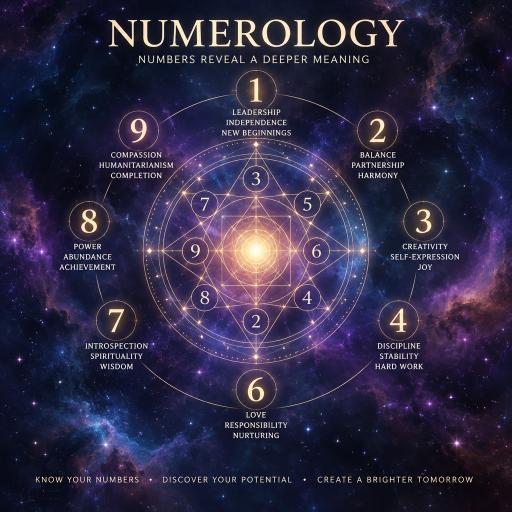
1: The Pioneer
A 1 project favors originality, leadership, and bold beginnings. It may work best when it has a clear creator or decisive direction. Its challenge is isolation: independence should not become resistance to useful feedback.
2: The Bridge
A 2 project thrives through partnership, sensitivity, and careful attention to relationships. It may unite people or perspectives. Its challenge is indecision, especially when maintaining harmony becomes more important than making progress.
3: The Voice
A 3 project centers on expression, storytelling, humor, beauty, or social connection. It benefits from playfulness and visibility. Its challenge is scattered effort; inspiration needs enough discipline to reach completion.
4: The Foundation
A 4 project values systems, craftsmanship, reliability, and long-term usefulness. It often grows slowly but can become durable. Its challenge is rigidity. A strong plan should support the work without preventing adaptation.
5: The Experiment
A 5 project seeks variety, movement, freedom, and change. It may suit travel, media, innovation, or unconventional formats. Its challenge is instability, so flexible deadlines and short milestones can be more effective than one distant goal.
6: The Offering
A 6 project is connected with care, teaching, beauty, responsibility, or community. It often aims to improve people’s daily lives. Its challenge is perfectionism or taking responsibility for everyone involved.
7: The Inquiry
A 7 project favors research, contemplation, spiritual exploration, or specialized knowledge. It may need privacy before public exposure. Its challenge is remaining hidden for too long or endlessly preparing instead of sharing.
8: The Enterprise
An 8 project concerns organization, influence, resources, and tangible results. It can carry strong professional or financial potential. Its challenge is defining success too narrowly and neglecting the values that inspired the work.
9: The Legacy
A 9 project often addresses compassion, completion, cultural memory, or a broad human theme. It may be intended for a diverse audience. Its challenge is excessive scope: trying to serve everyone can make the project difficult to finish.
What About Master Numbers?
If your calculation produces 11, 22, or 33 before the final reduction, you may choose to retain it. An 11 project is often interpreted as visionary or inspirational, but it may carry nervous intensity. A 22 project is associated with constructing something ambitious that serves many people. A 33 project emphasizes compassionate communication, teaching, or healing.
Master numbers should not be viewed as superior. They can simply represent a more demanding version of their reduced forms: 11 also contains the qualities of 2, 22 those of 4, and 33 those of 6.
Using the Signature During Difficult Phases
The most useful moment to revisit a Project Signature may be when the work stalls. Instead of asking whether the number guarantees success, ask whether you are cooperating with its symbolic qualities.
If a 3 project feels lifeless, has play and communication disappeared from the process? If a 4 project is chaotic, would a schedule or clearer structure help? If a 7 project is stuck in research, is it time to reveal an imperfect first version? For an 8 project, are practical goals serving the vision, or replacing it?
You can also translate the number into one concrete practice. A 2 project might benefit from a trusted collaborator. A 5 project could use monthly experiments. A 6 project may need explicit boundaries, while a 9 project might require a carefully defined ending.
A Number as a Creative Question
Calculating a Project Signature turns an abstract numerological exercise into a conversation with your work. The result is not a command, verdict, or promise. A title may change, a launch may be postponed, and the character of a project may evolve. Those shifts are part of the process rather than evidence that the calculation has failed.
Ultimately, the most revealing question is not “What will this number make happen?” but “What does this number invite me to notice?” Used in that spirit, project numerology can help creators see familiar ideas from a fresh angle—and give a developing work the attention its unique identity deserves.