

The Numerology of Thresholds: Reading the Hidden Number of a Home
Numerology is usually associated with birth dates, names, and life-path numbers. Yet numbers also accompany us through physical space. They appear on front doors, apartment buzzers, hotel rooms, office suites, and the floors of tall buildings. These ordinary labels can be viewed as more than practical coordinates: in symbolic numerology, they form a numerical threshold between the outside world and the life unfolding within.
The numerology of thresholds is a way of exploring how an address feels rather than predicting exactly what will happen there. A home number can be treated as an archetype—a recurring theme that may influence how residents perceive and use a space. One address might emphasize independence, while another seems to encourage hospitality, introspection, or constant activity.
This approach is not a science, and there is no evidence that a number controls the events inside a building. Its value lies in reflection. By assigning symbolic qualities to a home number, residents can ask useful questions about atmosphere, habits, relationships, and the role a particular place plays in their lives.
Finding the Core Number of a Home
The simplest method is to add the digits of a house or apartment number until only one digit remains. For example, a person living at number 472 would calculate:
4 + 7 + 2 = 13, then 1 + 3 = 4.
The core vibration of the address would therefore be 4. If the number is 38, the calculation becomes 3 + 8 = 11. Some numerologists preserve 11, 22, and 33 as “master numbers” instead of reducing them immediately. Others read both levels, interpreting 11 as a heightened form of 2 because 1 + 1 equals 2.
Letters can also be converted into numbers when they are essential to the address. Using the common Pythagorean system, the alphabet repeats in cycles from 1 to 9:
- 1: A, J, S
- 2: B, K, T
- 3: C, L, U
- 4: D, M, V
- 5: E, N, W
- 6: F, O, X
- 7: G, P, Y
- 8: H, Q, Z
- 9: I, R
Apartment 12B, for instance, can be read as 1 + 2 + 2, producing 5. However, it is often more revealing to interpret the building number and apartment number separately. The building may describe the shared environment, while the individual unit reflects the resident’s private experience.
The Nine Threshold Archetypes
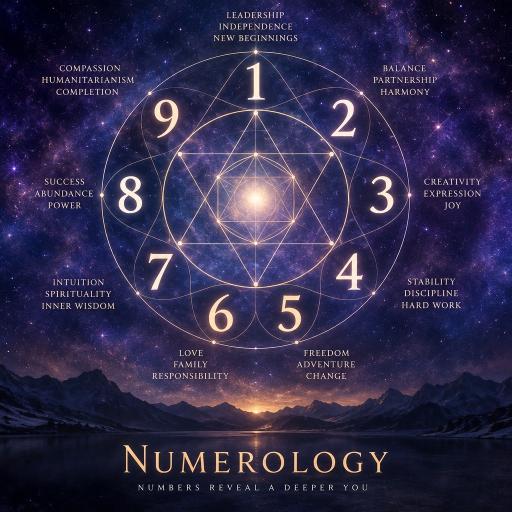
1: The House of Beginnings
A 1 home symbolizes independence, initiative, and fresh starts. It may suit someone launching a business, living alone for the first time, or rebuilding life after a major change. Its challenge is isolation: residents may become so self-reliant that they forget to ask for help. Creating a welcoming entrance can soften the strongly individual tone.
2: The House of Partnership
The number 2 is associated with cooperation, sensitivity, and emotional awareness. Such a home may become a place for couples, close friendships, or quiet reconciliation. Harmony matters here, but avoiding disagreement can create tension beneath the surface. Balanced pairs—two lamps, two chairs, or symmetrical decorations—can express its symbolism without forcing literal belief.
3: The House of Expression
A 3 address suggests conversation, creativity, humor, and social activity. It may feel especially lively when used by artists, writers, performers, or families with children. The shadow of 3 is scattered attention. Projects begin enthusiastically but may remain unfinished. A visible calendar or dedicated creative area can help transform inspiration into consistent practice.
4: The House of Foundations
The number 4 represents order, discipline, reliability, and structure. A 4 home can feel stable and practical, favoring routines, long-term planning, and gradual improvement. At times, however, it may seem overly serious or resistant to change. Color, music, and flexible furniture arrangements can introduce playfulness without sacrificing security.
5: The House of Movement
A 5 home symbolizes variety, freedom, travel, and experimentation. Visitors may come and go frequently, schedules may change, and residents may resist rigid domestic habits. This can be stimulating but also restless. The key is to establish a few dependable anchors, such as a regular shared meal or a calm corner that remains uncluttered.
6: The House of Care
The archetype of 6 centers on responsibility, beauty, family, and service. These homes are often imagined as nurturing spaces where people gather for food, advice, or comfort. The challenge is over-responsibility. One resident may become the caretaker for everyone else. Healthy boundaries are therefore as important as warm lighting, comfortable seating, and signs of hospitality.
7: The House of Reflection
A 7 address is linked with study, privacy, spirituality, and deep thought. It may appeal to researchers, contemplatives, readers, or anyone needing refuge from noise. Yet its quiet quality can become withdrawal. Residents can balance solitude by scheduling social contact rather than waiting until they feel completely ready to reconnect.
8: The House of Ambition
The number 8 is associated with authority, material management, achievement, and exchange. A home carrying this symbolism may focus attention on careers, finances, ownership, or leadership. Its lesson is ethical power: success should not come at the cost of well-being. Keeping financial records organized and displaying meaningful—not merely expensive—objects can support a healthier interpretation of abundance.
9: The House of Completion
A 9 home represents compassion, release, wisdom, and the closing of cycles. It may become a transitional place where residents finish an important chapter, simplify their possessions, or become involved in community causes. Because 9 is connected with letting go, sentimental clutter can be especially noticeable. Thoughtful donation and repair rituals may help the space feel renewed.
What About Zero and Master Numbers?
Zero is unusual because it contributes no numerical value during reduction, yet symbolically it can be read as an amplifier, a void, or a field of potential. Number 40 still reduces to 4, but the zero may suggest that questions of stability and structure are experienced on a larger or more open-ended scale. This is an interpretive addition, not a universal numerological rule.
Master number 11 is commonly associated with intuition, inspiration, and heightened sensitivity. As a home number, it may feel creative and emotionally charged, although it still carries the relational lessons of 2. Number 22 is often called the “master builder,” joining large vision with practical construction; it also reduces to the grounded 4. Number 33 is connected with teaching and compassionate service while retaining the domestic themes of 6.
Master numbers should not be treated as automatically superior. Their symbolism is often described as more demanding rather than more fortunate. Reading both the master number and its reduced digit produces a more balanced interpretation.
The Threshold Number Is Only One Layer
A full address can contain several symbolic levels. The street number may represent the immediate home, the apartment number the private interior, and the postal code the broader community. Trying to combine every digit, however, can produce a confusing mass of interpretations. It is usually better to begin with the number physically displayed on the resident’s own door.
Personal context matters just as much. A 5 home may feel liberating to one person and exhausting to another. A 4 address may offer welcome stability after years of uncertainty, while someone already living under strict routines may experience it as restrictive. Numerology becomes most meaningful when the symbolism is compared with actual experience rather than imposed upon it.
Creating a Personal Threshold Practice
To explore the number of a home, stand outside the entrance and observe what the doorway communicates. Is it easy to find? Is the number visible? Does the area feel protected, neglected, formal, playful, or inviting? Then calculate the core number and compare its traditional archetype with your first impression.
Choose one practical action that expresses the number’s constructive side. In a 1 home, begin a delayed project. In a 2 home, create space for conversation. In a 3 home, display art. In a 4 home, repair something broken. In a 5 home, introduce a new experience. In a 6 home, improve comfort without taking on more obligations. In a 7 home, establish a reading corner. In an 8 home, organize household finances. In a 9 home, release unused belongings.
The purpose is not to obey an address or fear an “incompatible” number. A threshold number works best as a symbolic prompt. It helps translate an abstract digit into a question: What kind of life am I building here? The answer comes not from the number alone, but from the choices made each time the door is opened.