

The 1440‑Code: Micro‑Moment Numerology for Designing Your Day
Numerology often focuses on grand arcs—your Life Path, your Personal Year, auspicious dates. But what if the subtlest magic hides in the micro? Imagine your day not as a blur of tasks but as 1,440 distinct minutes, each carrying a unique numerical flavor you can learn to feel and practically harness. I call this approach the 1440‑Code: a method for pairing the numerological character of any minute to the rhythms that best suit you, creating a compact “weather map” for your hours.
This is not about rigid rules or superstition. It’s a light, tactical framework to stack the deck in favor of flow. When your attention, your calendar, and your core numbers cooperate—even briefly—you get a few percentage points of extra ease. Compound that minute by minute, and your day starts to hum.
Why minutes matter
We habitually treat time as a commodity, but numerology suggests time has texture. The same phone call at 09:14 may land differently at 14:09. If you’ve ever felt “right place, right time” without knowing why, you already understand the intuition behind the 1440‑Code. Micro‑alignment won’t solve every challenge, but it can reduce friction, cut decision fatigue, and make small moments feel more intentional.
Your Anchor Triad
To make this practical, start with three reference numbers—your Anchor Triad. Think of them as your home frequencies.
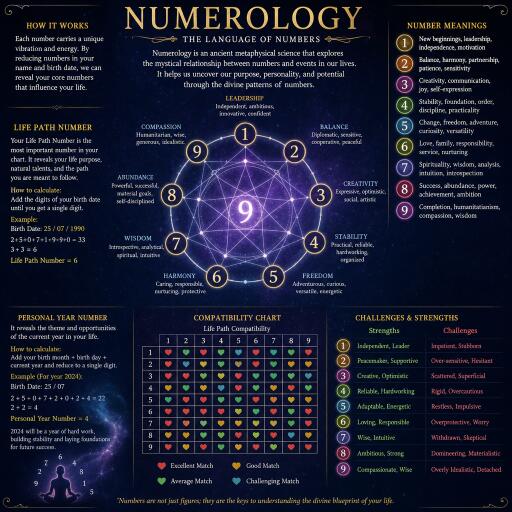
- Life Path Number: Sum your birth date (YYYY+MM+DD) to a single digit, allowing 11 and 22 as master numbers if they appear at the final stage. Example: 1990‑07‑25 → 1+9+9+0+0+7+2+5=33 → 6.
- Expression (or Destiny) Number: Reduce the letters of your full birth name using the Pythagorean map (A=1 through I=9, then J=1 through R=9, S=1 through Z=8), sum and reduce, honoring 11 and 22 if they land at the end.
- Day Vibe Number: Reduce today’s calendar date to a single digit (again, keep 11 or 22 if it arrives at the final step). This continually refreshes your third anchor so each day has a distinct “pulse.”
Example anchors: Life Path 7, Expression 3, Day Vibe 5 → Anchor Triad {7, 3, 5}. You’ll look for minutes that match or harmonize with these numbers.
The Minute Signature
Every minute in your day has a Minute Signature: a simple reduction of its 24‑hour time stamp.
- Write the time in 24‑hour format (HH:MM). 2:07 p.m. becomes 14:07.
- Sum all digits (ignoring the colon). 14:07 → 1+4+0+7=12.
- Reduce to a single digit: 12 → 1+2=3. If your sum is 11 or 22, you may keep it as a master signature for extra emphasis.
That’s it. The minute 14:07 carries a signature 3. We’ll use these signatures to match moments to activities.
The Resonance Map: What each number does best
Below is a concise portrait for each number and its natural harmonics. “Harmonics” are friendly allies that share compatible traits—use them as expanded windows of good timing. If a minute matches your Anchor Triad or any of its harmonics, treat it as a resonant window.
- 1: Initiation, decision, solo focus, first steps. Harmonics: 3, 5.
- 2: Partnership, preparation, listening, diplomacy. Harmonics: 4, 6.
- 3: Creativity, communication, brainstorming, performance. Harmonics: 1, 5, 9.
- 4: Structure, systems, routines, operations. Harmonics: 2, 8.
- 5: Movement, exploration, marketing, flexibility. Harmonics: 1, 3.
- 6: Care, refinement, teaching, harmonizing. Harmonics: 2, 3, 9.
- 7: Research, analysis, reflection, spiritual practice. Harmonics: 9.
- 8: Execution, leadership presence, resource management, outcomes. Harmonics: 4.
- 9: Integration, big‑picture, publishing, closure, altruism. Harmonics: 3, 6.
Master numbers can serve as amplifiers: 11 heightens 2’s relational magic with intuitive sparkle; 22 supercharges 4’s building power toward visionary outcomes. When a master Minute Signature appears (e.g., 10:01 → 2, but 10:10 → 1+0+1+0=2, not master; a true 11 or 22 comes from 00:29 → 11, 05:50 → 10 → 1), you can lean in confidently for moments of meaning, insight, or decisive build energy.
Turning minutes into windows
A minute is brief, so treat signatures as micro‑windows that last a few minutes on either side. Practically, work in 5–15 minute blocks. When a resonant or harmonic signature arrives, nudge your next micro‑action into alignment:
- Resonant window: The Minute Signature equals one of your anchors. Prioritize high‑value moves (send that pitch, start the chapter, step into the call).
- Harmonic window: It matches one of your anchor’s harmonics. Use it for supportive tasks (outline, draft, rehearse, prep).
- Neutral window: Anything goes. Keep momentum with maintenance work.
- Friction window: If it feels off, downgrade the task or switch to a neutral activity until a better signature arrives.
Example in action
Suppose your Anchor Triad is {7, 3, 5} (Life Path 7, Expression 3, Day Vibe 5). Your workday includes research, writing, outreach, and a presentation.
- 07:16 → 0+7+1+6=14 → 5. Signature 5 harmonizes with 7’s curiosity and 3’s expression. Great for ideation while walking or outlining a talk.
- 09:42 → 0+9+4+2=15 → 6. Not an anchor nor primary harmonic here. Use it for polish: tidy your deck, refine visuals.
- 11:08 → 1+1+0+8=10 → 1. A dynamic ignition moment. Start the first slide live rehearsal, make a decisive cut to keep it tight.
- 13:34 → 1+3+3+4=11. Master window. Present a draft to a trusted colleague and invite intuitive feedback.
- 14:07 → 1+4+0+7=12 → 3. Anchor match. Go on camera, record the intro, or deliver your presentation.
- 15:55 → 1+5+5+5=16 → 7. Anchor match. Debrief solo: journal what worked, capture insights for next time.
This isn’t about perfection. It’s about catching smooth currents whenever they pass under your keel.
Minute mantras: Micro‑intentions for each number
Pair signatures with tiny, repeatable intents. These train your nervous system to pivot smoothly.
- 1: “Begin.” One clean action, no dithering.
- 2: “Listen.” Invite input, attend to details.
- 3: “Express.” Say it, sketch it, share it.
- 4: “Build.” Put one brick on the last brick.
- 5: “Explore.” Move, test, vary.
- 6: “Tend.” Care, edit, harmonize.
- 7: “Inquire.” Ask the deeper question.
- 8: “Deliver.” Own the room, close the loop.
- 9: “Elevate.” Connect this to the larger arc.
- 11: “Receive.” Note the spark; trust the hunch.
- 22: “Architect.” Sketch the scaffolding and set stakes.
Weaving the weekly pulse
The Day Vibe number keeps your Anchor Triad alive. On a 9 day, give extra room to wrap‑ups and publishing. On a 4 day, lean into systems. A simple practice:
- Compute the Day Vibe each morning (reduce YYYYMMDD).
- Circle three 30‑minute blocks you can protect. Within each block, aim to start key moves on minutes matching the Day Vibe or your other anchors.
- Use harmonics to cluster related tasks. For instance, on a 6 Day Vibe, signatures 2, 3, and 9 make an excellent teaching‑and‑editing arc.
Edge cases and simple fixes
- 12‑hour clocks: Convert to 24‑hour first (e.g., 2:41 p.m. = 14:41).
- Seconds: Ignore them; they add noise. If you love precision, only use seconds to break ties on master windows.
- Time zones: Your local clock rules your body’s rhythm. When traveling, give yourself a day to “retune.”
- Back‑to‑back repeats: If you hit several neutral or friction windows, scale down the task. Save the peak move for the next resonant or harmonic minute.
The seven‑day experiment
Try this once and you’ll “get it,” but a week of practice will show patterns you can trust.
- Day 1: Calculate your Anchor Triad. Note the Day Vibe and mark 10–15 resonant/harmonic minutes across your calendar.
- Day 2: Assign micro‑tasks to those minutes. Use the minute mantras as prompts.
- Day 3: Track energy and outcomes. Use a simple 1–5 ease score for each micro‑move.
- Day 4: Adjust harmonics. If a number consistently feels helpful, adopt it as a “friendly” even if it’s not on the default map.
- Day 5: Introduce one master window ritual (11 = Intuitive Check; 22 = Structural Commit).
- Day 6: Design a 90‑minute wave: start on a 1 or 3, build through 4 or 8, close on 9.
- Day 7: Review your log. Highlight three insights: a time that sings, a task that likes a specific number, and a number that calms you.
By the end, you’ll have a bespoke resonance key—your unique timing palette—based not on theory alone but on lived feedback.
Design tips for common goals
- Starting something new: Aim for 1 to kick off, 3 to share early, 4 to stabilize, and 8 to ship.
- Deep research: Anchor in 7 windows; sprinkle 9 for synthesis; use 2 or 6 for collaborative review.
- Creative work: Ideate in 3 or 5; structure in 4; refine in 6; publish in 9.
- Team coordination: 2 for check‑ins, 6 for teaching/mentoring, 8 for decision meetings.
What if you can’t choose the time?
Life doesn’t always let you pick. If a scheduled call lands on a mismatched minute, create a micro‑bridge:
- Pre‑tune: Spend 90 seconds just before the event in a resonant signature (even stepping into the minute that precedes it).
- Reframe: Use the minute mantra of the actual signature to set an intention that suits its flavor.
- Post‑process: If the moment felt bumpy, perform a quick closing action during your next resonant window (a note, a summary, a follow‑up).
Why this works (softly)
Numerology gives you a language for pattern and pacing. The 1440‑Code becomes a decision aid—small nudges delivered just in time. Even if you treat it purely as a mindfulness tool, it reduces dithering. Less time wondering “When should I do this?” means more time doing the right next thing.
Think of it as choreography for attention: step when the beat hits, pivot when the rhythm changes, rest between bars.
Ethics and agency
No number is a tyrant. Your intuition and circumstances come first; the 1440‑Code is a compass, not a cage. If a moment feels wrong for the “right” number, trust your felt sense and adjust. Over time, you’ll refine a personal resonance map that makes your days less mechanical and more musical.
In closing
There are 1,440 moments inside every sunrise. When you learn the signature of a minute and match it to who you are, tiny doors open. You start at the right time more often. You switch lanes without grinding your gears. You finish with a sense that the day wasn’t just spent—it was composed. Start with your Anchor Triad, listen for the numbers that sing, and let your calendar become a score you can play with grace.