

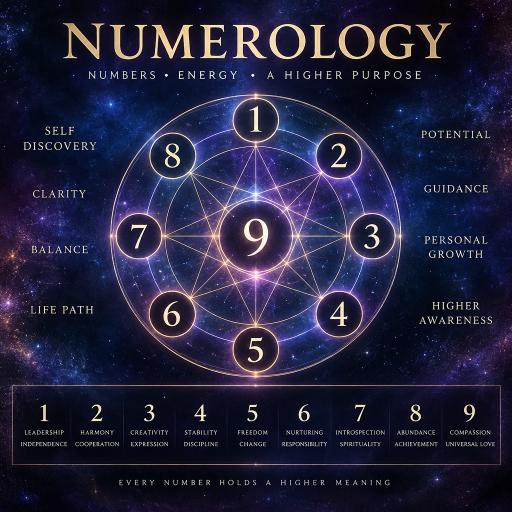
The Numerology of Unfinished Things: A Reflective Method for Reviving or Releasing Dormant Projects
Most numerology focuses on beginnings: birth dates, names, new homes, relationships, and favorable moments for launching something. Yet daily life is also shaped by what remains incomplete—the manuscript in a drawer, the course abandoned halfway through, the business idea saved in a forgotten folder, or the room that has been waiting months to be reorganized.
These unfinished projects often retain emotional weight. Even when we are not actively working on them, they occupy attention and can generate guilt, curiosity, or a persistent sense of possibility. The following practice uses numerology as a symbolic framework for examining that weight. It is not a traditional school of numerology or a scientific method. Instead, it is a creative exercise designed to help you decide whether an unfinished undertaking should be revived, redesigned, delegated, or consciously released.
Why Unfinished Projects Have Their Own Symbolic Energy
A project begins with one intention but may stop under entirely different circumstances. Perhaps enthusiasm faded, practical responsibilities intervened, or the original goal no longer matched the person you became. This creates a gap between the project’s initial identity and its present meaning.
Numerology can provide language for exploring that gap. By reducing words and dates to single-digit values, we create symbols that encourage focused questions. The value is not in assuming that a number controls the outcome. The value lies in using the number as a mirror: a prompt that may reveal what ordinary planning has overlooked.
In this method, every dormant project is given three numbers:
- The Seed Number, representing the project’s original intention.
- The Pause Number, representing the circumstances surrounding its interruption.
- The Return Number, representing the approach most useful now.
Step One: Calculate the Seed Number
Write down the short name you naturally use for the project. Avoid creating a grand or artificial title merely to obtain a desirable result. If you usually call it “Garden Plan,” use that phrase rather than something elaborate such as “The Magnificent Garden Transformation.”
Apply the common Pythagorean letter chart:
| Number | Letters |
|---|---|
| 1 | A, J, S |
| 2 | B, K, T |
| 3 | C, L, U |
| 4 | D, M, V |
| 5 | E, N, W |
| 6 | F, O, X |
| 7 | G, P, Y |
| 8 | H, Q, Z |
| 9 | I, R |
Add the values of all letters and reduce the total by adding its digits until you reach a number from 1 to 9. For example, “Garden Plan” becomes:
G(7) + A(1) + R(9) + D(4) + E(5) + N(5) + P(7) + L(3) + A(1) + N(5) = 47; 4 + 7 = 11; 1 + 1 = 2.
The Seed Number is therefore 2. This suggests that the project may originally have been rooted in cooperation, patience, harmony, or the desire to create a supportive environment.
Step Two: Find the Pause Number
Use the date on which you last made meaningful progress. If you do not remember the exact day, use the closest date you can verify from a file, message, photograph, calendar entry, or receipt. Add every digit of the date and reduce the result.
Suppose the last work on the garden plan occurred on May 18, 2024:
5 + 1 + 8 + 2 + 0 + 2 + 4 = 22; 2 + 2 = 4.
The Pause Number is 4. Symbolically, four concerns structure, labor, routines, limitations, and practical foundations. This might indicate that the idea stalled when it encountered logistical realities: budget, time, tools, measurements, or the need for consistent maintenance.
The Pause Number should not be interpreted as blame. Instead, ask what the number reveals about the point of friction. A creative project pausing under a four may have needed a schedule. A project pausing under a five may have suffered from distraction or changing priorities. Under a seven, it may have entered a period of doubt, research, or withdrawal.
Step Three: Derive the Return Number
Add the Seed Number and Pause Number, then reduce the result. In the example, Seed 2 plus Pause 4 produces a Return Number of 6.
The Return Number does not promise that the project will succeed. It suggests a constructive attitude for revisiting it. A six emphasizes care, responsibility, usefulness, and beauty. The garden plan might therefore be revived by making it easier to maintain, involving family members, or focusing on a welcoming space rather than an impressive design.
Meanings of the Nine Return Numbers
- One: Restart independently. Simplify the concept and take one decisive action. Do not wait for universal approval.
- Two: Seek cooperation. Find a partner, listener, editor, or accountability companion. Progress may require patience rather than force.
- Three: Restore enjoyment. Introduce play, communication, color, or experimentation. The project may have become too serious.
- Four: Build a system. Create a budget, checklist, timeline, workspace, or repeatable routine before pursuing inspiration.
- Five: Change the format. Allow movement and adaptation. A book could become a newsletter; a large trip could become a local excursion.
- Six: Make it useful. Connect the project with care, home, community, teaching, or tangible improvement in someone’s life.
- Seven: Reconsider the purpose. Research, reflect, and remove external expectations. The right next step may be private study.
- Eight: Address resources. Examine money, authority, scale, ownership, and measurable outcomes. Treat the project professionally.
- Nine: Complete or release. Finish the smallest meaningful version, share what was learned, or formally let the project go.
Working With Master Numbers
Some numerologists preserve 11, 22, and 33 rather than immediately reducing them. You may do so if those numbers are part of your usual practice, but interpret them in grounded terms.
- 11 can invite a clearer vision, message, or source of inspiration.
- 22 can emphasize translating an ambitious idea into practical stages.
- 33 can highlight teaching, service, compassion, or excessive responsibility.
After considering the master-number theme, also examine its reduced value: 11 becomes 2, 22 becomes 4, and 33 becomes 6. This prevents an impressive label from replacing practical action.
A Four-Question Project Reading
Once you have calculated the three numbers, write brief answers to these questions:
- What did I originally hope this project would give me or others?
- What practical or emotional condition existed when I stopped?
- How does the Return Number challenge my usual way of working?
- What action can I complete in less than 30 minutes?
The final question is essential. Symbolic interpretation becomes useful only when translated into a real choice. A Return Number of four might lead to making a checklist. A five might suggest testing a new format. A nine could inspire deleting obsolete files, donating unused materials, or writing a short closing note about what the experience taught you.
Revival Is Not Always the Right Outcome
Popular productivity advice often assumes that every unfinished task represents failure. That is not true. Some projects belong to earlier identities, temporary interests, or circumstances that no longer exist. Keeping them alive can consume more energy than completing them would create.
Numerology should not pressure you into continuing an expensive, harmful, or unrealistic commitment. It should also never replace financial, medical, legal, or mental health advice. If the exercise confirms that you no longer value a project, conscious release is a valid form of completion.
You can mark that release with a simple ritual: record the project’s three numbers, write one lesson you are keeping, and choose one physical action that closes the chapter. Archive the folder, recycle the notes, cancel the subscription, or give the materials to someone who will use them.