

City Codes: Mapping Your Urban Energy with Numerology
What if your city had a numerological fingerprint—and you could read it? Every day, we move through a landscape thick with numbers: building addresses, unit numbers, transit routes, bike-share docks, parking stalls, even the digits on coffee loyalty cards. An “urban numerology” lens invites you to notice those figures not as random labels, but as energetic signposts. By mapping your habitual paths through the city against your own core numerology, you can experiment with subtle shifts in routing, timing, and place selection to align your daily flow with your intentions.
Why Urban Numerology?
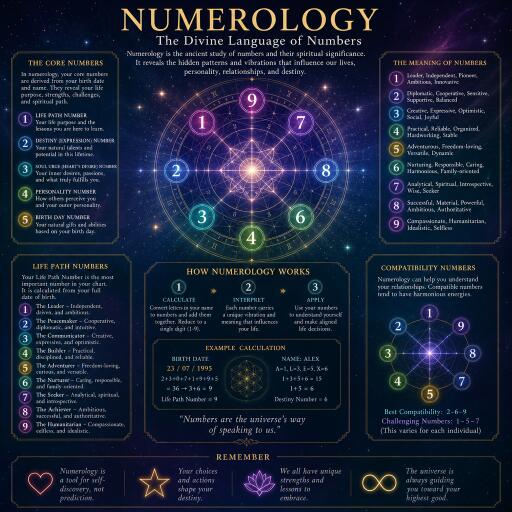
Traditional numerology interprets numbers as archetypal vibrations—1 initiates, 2 harmonizes, 3 expresses, and so on. Urban numerology simply applies that same symbolic logic to the grid of modern life. The 8 on your office tower may whisper about ambition and structure; the 5 bus line might carry a charge of versatility and surprise. Your schedule and your surroundings already teem with number patterns. The experiment is to consciously curate them.
Core Method: Reducing Numbers and Noting Master Numbers
The backbone is simple digit reduction:
- Sum all digits until you reach a single digit 1–9. Example: 742 → 7+4+2=13 → 1+3=4.
- Master numbers 11 and 22 are sometimes kept intact as intensified versions of 2 and 4. In a city map, you can either reduce them (11→2, 22→4) for simplicity, or flag them with an asterisk to note their heightened tone.
We’ll treat addresses, transit lines, floors, and unit numbers as “sites of influence,” reduce them, and then look for patterns that either support or scatter your intentions.
Step-by-Step: Build Your City Energy Map
-
Clarify your aim.
Pick a focus for the next 6–12 weeks. Examples: deep work (4 energy), career expansion (8), community and partnership (2), or creative visibility (3). Having a theme helps you spot supportive numbers more easily.
-
Calculate your anchor numbers.
Two quick anchors keep the practice personal:
– Life Path (broad life current): Sum your full birth date to a single digit. Example: 1991-08-15 → 1+9+9+1+0+8+1+5 = 34 → 3+4 = 7.
– Personal Year (seasonal emphasis): Sum your birth month and day with the current year. Example for 2026: Aug 15 → 0+8+1+5+2+0+2+6 = 24 → 2+4 = 6.These aren’t rules; they’re lenses. If your Life Path is 7 and this year is a 6 year for you, you may navigate best through introspective, research-rich environments (7) while tending to home, care, and harmony (6).
-
Gather your city data.
List the places and paths you frequent:
– Home address number and unit/floor
– Workplace or main workspace (coworking suite, campus building)
– Usual transit lines, exit gates, parking stalls
– Regular stops: café, gym class studio number, library branch
– Weekly errands: market stall numbers, dry cleaner addressReduce each to a digit. If a number naturally presents as 11 or 22, you may note it as such.
-
Weight by frequency.
Mark how often you visit each place and how long you spend there. A 7-energy retreat you visit once a month counts less than your daily 5-energy commute. Consider a simple rating: Daily (3 points), Weekly (2), Monthly (1).
-
Sketch the map.
On a paper map or a digital map layer, label each spot with its number. Draw lines to show your typical routes and annotate each with the route’s number energy. You now have a visual of the numerical weather you move through.
Urban Energies at a Glance
Think of these as archetypes you can test against your lived experience:
- 1 — Initiative, independence, speed. Good for launches, taking the lead, quick decisions. In cities: fast corridors, decisive wayfinding.
- 2 — Harmony, partnership, receptivity. Ideal for collaboration and diplomacy. In cities: quieter streets, shared desks, calming nooks.
- 3 — Expression, creativity, social spark. Networking, performance, brainstorms. In cities: lively cafés, arts districts, stages.
- 4 — Structure, stability, discipline. Deep work, routines, systems. In cities: libraries, offices, gridlike streets, predictable transit.
- 5 — Freedom, change, movement. Exploration, marketing, travel. In cities: cross-town lines, markets, pop-ups.
- 6 — Care, community, aesthetics. Hosting, mentoring, home matters. In cities: neighborhood centers, gardens, design studios.
- 7 — Insight, research, solitude. Study, analysis, spiritual practice. In cities: archives, nature reserves, quiet upper floors.
- 8 — Power, ambition, results. Negotiation, finance, leadership. In cities: high-rises, business districts, boardrooms.
- 9 — Completion, impact, service. Publishing, advocacy, synthesis. In cities: universities, civic spaces, museums.
- 11 — Illumination, inspiration (amplified 2). In cities: think tanks, labs, incubators with a visionary bent.
- 22 — Master builder, large-scale structure (amplified 4). In cities: headquarters, large campuses, infrastructure hubs.
Weaving Time: Match Routes to Your Day Number
Space is half the picture; time is the other. Calculate a quick Personal Day by adding your Personal Year to the month and day of the date, then reducing to a digit. Example: If your Personal Year is 6 and today is 09/18: 6+0+9+1+8=24 → 2+4=6. On a 6 day, choose paths and places with 6 energy if possible—perhaps meet in a 24 Main Street café (2+4=6) rather than the 173 Market (1+7+3=11/2) if your aim is comfort and rapport.
The 3-Route Filter
When you have multiple ways to travel:
- Reduce each route’s main number (bus 14 → 1+4=5; subway line 2 → 2; tram 7 → 7).
- Pick the route whose number best fits your day’s aim (5 for exploration days, 4 for disciplined focus days).
- Keep practicality first: if the “aligned” choice adds an unsafe detour or major delay, adapt by adding a numerically aligned micro-choice (e.g., choose a 4-energy seat row or exit gate).
Case Study: Maya’s Commute Makeover
Maya, Life Path 8, entered a 6 Personal Year. She worked in Suite 1730 (1+7+3+0=11/2) of a tower at 240 King (2+4+0=6), commuting via Bus 23 (2+3=5). Her week felt scattered: constant context switching, little time for strategic work.
She mapped it:
– Home: 51 Glen (5+1=6)
– Coworking: Suite 304 (3+0+4=7) on Tuesdays
– Gym: Studio 44 (4+4=8)
– Café: 132 Oak (1+3+2=6)
– Commute options: Bus 23 (5), Metro Line 4 (4), or a 15-minute walk through 9th Avenue (9)
Observations:
– Strong 6 undertone (home and building), consistent with her Personal Year’s need for care and cohesion.
– The daily route (Bus 23 → 5) injected volatility—great for sales sprints, not for her current focus.
– Her office suite vibrated at 2 (via 11/2), supportive for team relations but a bit soft for her 8-driven strategic blocks.
Experiments:
– Twice a week, she took Metro Line 4 (structure) and scheduled deep-work blocks upon arrival. She also booked a quiet 8th-floor huddle room (8) for negotiations.
– She swapped one social coffee at 132 Oak (6) for a solo hour at 304 coworking (7) before meetings, using 7’s investigative tone to prep.
– On 5-day dates (Personal Day math), she embraced the Bus 23 chaos intentionally for networking runs.
Result after four weeks: She reported fewer scattered mornings, more consistent progress on a proposal, and better timing for outreach—subjectively correlating her outputs to the routes chosen for the day’s purpose. No magic switch, just subtler alignment reinforcing priorities.
If You Can’t Choose the Number, Balance It
Sometimes the tower you work in is a fixed 5, or your only bus is a 7. You can still shape the vibe:
- Micro-anchors: Choose a desk, locker, or seat number that expresses your desired energy. If the building is 5-heavy and you need 4’s discipline, request Locker 31 (3+1=4) or sit in Row 13 (1+3=4).
- Temporal tuning: Schedule tasks that match the site’s number. Do outreach (3) while riding a 3-energy line; do spreadsheets (4) when you arrive via a 4 route.
- Symbolic cues: Use colors or objects resonant with your target number in your workspace—subtle reminders that reinforce intention. For a 6 season, add a plant or a calming art print; for 8, keep a clear, minimalist desk for authority and results.
- Threshold rituals: Before entering a space with a challenging energy, set a one-minute intention matching your day or aim. Numerology is as much about conscious attention as it is about arithmetic.
DIY City Walk: Reading a Neighborhood by Numbers
Try a 45-minute stroll with a theme number. Suppose your theme is 3 (expression):
- Pick three blocks with addresses clustering around 12–39 (3-heavy reductions).
- Notice how you feel at corners where cross-streets add to 3 (e.g., 21st and 30th: 2+1=3, 3+0=3).
- Pop into a venue whose suite or street reduces to 3. Journal a few lines or sketch—test whether ideas flow more easily.
- On another day, repeat with a 4 theme. Compare mood, pace, and output. The goal is not proof but pattern literacy.
Digital Tools: Make It Practical
You can keep this practice light or geek out a bit:
- Spreadsheet: List sites, their numbers, frequencies, and notes on how you feel. Color-code by 1–9.
- Map layers: In Google My Maps or similar, create layers per number. Drop pins and see your city’s energetic mosaic.
- Calendar tags: Add the day’s number (D4, D7) to your calendar title. Glance-able cues help you pick routes and venues on the fly.
Number Meanings, Reframed for City Life
These compact mantras can guide quick choices at a station or lobby:
- 1 — “Start.” Choose the entrance that gets you moving. Pilot a fresh route.
- 2 — “Pair.” Invite someone to walk or ride with you. Choose the quieter platform.
- 3 — “Share.” Strike a conversation. Pick the lively café for ideation.
- 4 — “Build.” Take the consistent route. Sit where you won’t be interrupted.
- 5 — “Roam.” Try the scenic detour. Leave room for surprise.
- 6 — “Tend.” Pick the comfortable seat. Text someone you support.
- 7 — “Listen.” Headphones on, notes app open. Observe more than you speak.
- 8 — “Decide.” Use the express line. Confirm the meeting. Negotiate terms.
- 9 — “Give.” Offer your seat. Archive, publish, or share your notes.
FAQs and Guardrails
- Is this deterministic? No. It’s a reflective tool, not a rulebook. Let data (your mood, outcomes, feedback) be your guide.
- What if the “aligned” route is slower? Safety, accessibility, and real-world constraints come first. Insert micro-alignments where feasible.
- Do I have to keep master numbers? Only if they feel distinct to you. For many, keeping 11 and 22 as special adds nuance.
- Can I apply this to digital life? Yes—meeting IDs, file version numbers, and calendar slots all carry numeric textures. Tag them with intention.
Closing: Become a Translator of Your City’s Digits
Your city hums with number stories—on doors, platforms, screens, and schedules. Urban numerology doesn’t demand belief; it invites attention. By pairing intention (what you’re building) with observation (which numbers you move through), you give ordinary choices—Which bus? Which entrance? Which hour?—a chance to line up with your focus. Over weeks, these small alignments can create a felt difference in momentum and coherence.
Try it for one month: calculate your anchors, sketch a simple map, and pick a weekly theme number. Tweak one route, choose one numerically aligned seat, and schedule one task at a time that matches the day’s digit. Track what shifts. You may find that the city you thought you knew has been speaking a quiet numeric dialect all along—waiting for you to answer back.