

Transit Numerology: How Your Commute’s Hidden Numbers Can Shape the Day
We live inside streams of numbers: route signs, platform boards, license plates, clock faces. If you’re numerology-curious, your commute is a perfect daily laboratory—rich with visible, repeatable numbers you can actually choose and tweak. This article introduces Transit Numerology, an original framework for using the numbers embedded in your daily travel to nudge your day toward certain qualities—focus, flexibility, leadership, empathy, and more—while staying grounded, safe, and practical.
The Core Idea: Your Mobility Field Number
In Transit Numerology, you compose a single, simple signature called the Mobility Field Number (MF). It blends three numeric “tokens” you encounter or select during your commute:
- Route Number Signature (RNS): The number of your route, line, highway, or the first major street/building number on your path.
- Departure Time Tone (DTT): The energy of your chosen departure time (from your front door or when your vehicle starts moving).
- Vehicle/Waypoint Identity (VWI): A vehicle ID like a license plate or train car number. If you’re walking or cycling, use the first or destination building number you pass.
Reduce each token to a single digit (1–9) using standard numerology reduction (sum the digits repeatedly until one digit remains). Optionally, honor “master numbers” 11 and 22 whenever they appear at any step—don’t reduce them further unless you’re computing a final MF and it doesn’t land on 11 or 22 naturally.
Then, add RNS + DTT + VWI, and reduce to 1–9 (or keep 11/22 if the total naturally reduces to those). That’s your Mobility Field Number for that commute.
How to Calculate the Tokens
1) Route Number Signature (RNS)
- Highway or route: sum its digits. Example: Route 405 → 4+0+5 = 9.
- Subway/rail line: Line 7 → 7; Line 12 → 1+2 = 3.
- Walk/bike: use the first building number you pass or a key waypoint. Example: 245 → 2+4+5 = 11 (master 11).
2) Departure Time Tone (DTT)
- Write your departure in 24-hour or 12-hour format without punctuation and sum the digits. Example: 08:12 → 0+8+1+2 = 11 (master), 7:45 → 7+4+5 = 16 → 1+6 = 7.
3) Vehicle/Waypoint Identity (VWI)
- License plate or train car number: add digits. If letters are present, convert using the Pythagorean system (A/J/S=1; B/K/T=2; C/L/U=3; D/M/V=4; E/N/W=5; F/O/X=6; G/P/Y=7; H/Q/Z=8; I/R=9). Then sum all values.
- Non-vehicle: use your destination building number or another clear waypoint number you’ll definitely encounter.
Final MF: Add RNS + DTT + VWI and reduce to a single digit, keeping 11 or 22 if they appear as the final reduced value.
Quick Example
Say you take Line 7 at 08:12 and step into Car 2314:
- RNS: Line 7 → 7
- DTT: 0+8+1+2 = 11 (keep as master 11)
- VWI: 2+3+1+4 = 10 → 1
- MF: 7 + 11 + 1 = 19 → 1+9 = 10 → 1
Your Mobility Field Number is 1 for that ride—great for initiation and starting something new.
Aligning Your Commute with Personal Cycles
Numerology traditionally looks at “who you are” (Life Path Number) and “where you are in time” (Personal Year/Month/Day). Transit Numerology doesn’t replace those—it gives you a lever you can actually move daily (e.g., leave at 7:36 instead of 7:45) to harmonize with your cycles.
How to Find Your Personal Day
Here’s a common method:
- Personal Year: Reduce your birth month + birth day + the current year (YYYY). Example: for July 14 with year 2026: 7 + (1+4=5) + (2+0+2+6=10→1) = 7+5+1 = 13 → 4.
- Personal Month: Add the calendar month number to your Personal Year. Example: June (6): 4 + 6 = 10 → 1.
- Personal Day: Add the calendar day to your Personal Month and reduce. Example: Day 20: 1 + (2+0=2) = 3.
So for this example, the Personal Day is 3—an expressive, communicative vibe.
What Each Number Emphasizes
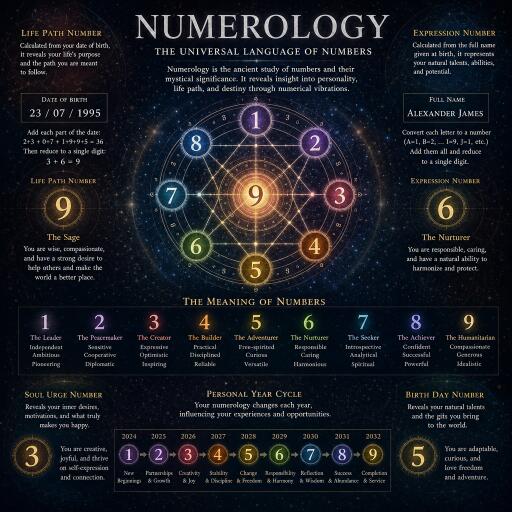
- 1: Initiative, independence, leadership, speed.
- 2: Partnership, diplomacy, patience, listening.
- 3: Creativity, expression, sociability, presentation.
- 4: Structure, focus, discipline, building blocks.
- 5: Change, adaptability, movement, sales/travel.
- 6: Care, harmony, responsibility, team support.
- 7: Insight, analysis, reflection, study.
- 8: Power, management, results, negotiation.
- 9: Completion, release, service, big-picture.
- 11 (master): Intuition, inspiration, flashes of clarity.
- 22 (master): Master-builder energy, systems, long-range construction.
When your MF matches or complements your Personal Day, you may feel “carried” by your commute rather than tripped by it. If your Personal Day is 3 (expression) but your MF is 1 (start), you can open with a bold message, then expand creatively throughout the day. If your Personal Day is 7 (quiet analysis) and your MF is 5 (change), you might protect your first hour for research before surfing the afternoon’s unpredictability.
Three Real-World Case Studies
1) The Metro Analyst
Commute: Line 7 at 08:12, Car 2314.
- RNS: 7
- DTT: 0+8+1+2 = 11 (master)
- VWI: 2+3+1+4 = 10 → 1
- MF: 7 + 11 + 1 = 19 → 1
Personal Day (example): 3.
Interpretation: MF 1 meets Day 3. The ride supplies the ignition spark; the day asks for messaging and creativity. Use the train time to outline your opening statement for a 10 a.m. presentation. Even a two-sentence thesis in your notes app will anchor the day. If you’re wobbly, sit nearer a car numbered with 1 or 10 (1+0=1) for a small psychological nudge.
2) The Sales Driver
Commute: Route 405 at 7:45. License “KDX-7132”.
- RNS: 4+0+5 = 9
- DTT: 7+4+5 = 16 → 7
- VWI letters: K(2) + D(4) + X(6) = 12 → 3; digits: 7+1+3+2 = 13 → 4; total: 3+4 = 7
- MF: 9 + 7 + 7 = 23 → 5
Personal Day (example): 8.
Interpretation: MF 5 (movement/change) with Day 8 (results/power). Ideal for on-the-fly route pivots and bold asks. Plan two optional stops you can add if momentum is high. Leave five minutes early or late to shift DTT if you want a subtler 4 (structure) or 6 (relationship) tone.
3) The Walking Creator
Commute: Pass 245 Elm at 09:30, destination 1207 Market.
- RNS (first building): 2+4+5 = 11 (master)
- DTT: 0+9+3+0 = 12 → 3
- VWI (destination): 1+2+0+7 = 10 → 1
- MF: 11 + 3 + 1 = 15 → 6
Personal Day (example): 2.
Interpretation: MF 6 (care/harmony) complements Day 2 (partnership). Perfect for co-creation—schedule a walking meeting, or voice-record ideas to share with a collaborator. If you’d like more spark, depart at 09:29 instead: 0+9+2+9 = 20 → 2, shifting MF toward a gentler, relational pair.
Tuning Your Commute on Purpose
You can actually steer your MF with small choices:
- Adjust the minute hand: Every minute you change shifts your DTT by roughly 1. Need a 4 (focus) instead of a 5 (flux)? Leave a minute earlier if your DTT is high, or two minutes if you need to cycle it around.
- Choose your route variant: If two lines get you there—Line 2 vs Line 3—pick the number whose energy you want. 2 for teamwork, 3 for expressive brainstorming.
- Pick your vehicle or car: If safe and practical, board a car with a number that supports your day. Even positioning near a door plaque with a favorable number can serve as a symbolic cue.
- For walkers/cyclists: Select a “first address” or destination address that yields your target energy when options exist (e.g., entering a complex via door 108 instead of 109).
Small, safe, and repeatable tweaks amplify intention. You’re not forcing fate; you’re framing your focus.
Matching and Complementing Personal Days
There’s no single “best” pairing, but these patterns are helpful:
- Match (e.g., Personal Day 4 and MF 4): Strong resonance. Great for locking in habits or executing exactly as planned.
- Complement (e.g., Day 3, MF 1): The commute provides ignition; the day elaborates. Excellent for kickoffs and pitches.
- Counterbalance (e.g., Day 7, MF 5): If the day leans inward but the commute is lively, set protective boundaries (noise-canceling headphones, a reserved seat) and transmute the bustle into research fuel.
- Master moments (11 or 22 present): Treat these as windows. 11 for intuition—journal or voice-note impressions. 22 for systems—sketch a two-step framework you can build on later.
Weekly Experiment You Can Try
- Baseline: For three days, record RNS, DTT, VWI, MF, and a one-line mood/performance note by noon and by evening.
- Target: Pick a quality you want more of this week (focus=4, connection=2, expression=3, adaptability=5, etc.).
- Tune: Adjust only the departure minute for two days to drift your DTT toward that number. If possible, swap route variants on day three.
- Reflect: Which change felt impactful—time or route? Keep what works; discard what doesn’t.
FAQs and Practical Notes
- Do I have to keep master numbers? Optional. If 11 or 22 show up in a token, you can honor them. For the final MF, keep them only if they arise naturally at the end.
- What if my plate or car number is long? Reduce it in parts (letters, then digits) before adding, then reduce the total.
- What if I transfer? Compute a new MF for leg two. You can also average the legs (reduce each MF, add, and reduce again) to get a meta-signature.
- Safety first: Never take risks to “chase a number.” If your ideal car is crowded or unsafe, skip it. Intention matters more than perfection.
Why Transit Numerology Works (Even If You’re Skeptical)
From a psychological angle, this practice creates a micro-ritual. You make a small, conscious choice each morning, then match your first actions to a single-word theme (focus, connect, initiate). That link between intention and action reduces friction and decision fatigue. Whether you view numbers as cosmic signals or as cognitive cues, the result can be the same: you show up more directed and less reactive.
Closing Thoughts
Your commute is a river of numbers you can step into differently each day. By combining a Route Number Signature, a Departure Time Tone, and a Vehicle/Waypoint Identity into your Mobility Field Number, you craft a gentle but potent steering mechanism for your morning energy. Align it with your Personal Day to surf the current, or counterbalance it when life tilts too far in one direction.
Try it tomorrow: pick your departure minute on purpose, compute your MF, and give your first hour a theme. The journey might feel a little less random—and a lot more yours.