

The Nine Windows: A Numerology-Inspired System for Daily Flow
Numerology is often used to explore identity and long arcs of destiny, but it can also be surprisingly practical. This article introduces an original framework—the Nine Windows—a numerology-inspired way to structure your day so that your energy, attention, and intentions line up with the archetypal qualities of the numbers 1 through 9. Think of it as a rhythm map that helps you decide when to start, when to collaborate, when to dive deep, and when to wrap up.
Why nine windows?
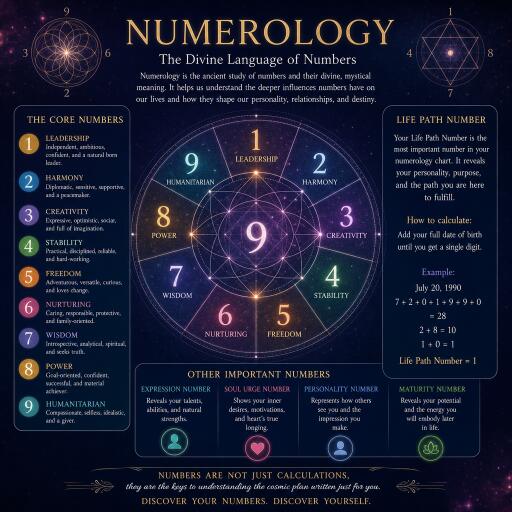
Classic numerology reduces numbers to the digits 1–9, each carrying a distinct “tone”:
- 1: Initiation, independence, decisive starts
- 2: Partnership, listening, balance
- 3: Creativity, expression, lightness
- 4: Structure, systems, foundations
- 5: Change, movement, adaptability
- 6: Care, service, harmony
- 7: Study, introspection, analysis
- 8: Leadership, strategy, material results
- 9: Integration, sharing, completion
The Nine Windows method maps these qualities onto nine time blocks during your waking hours. You don’t need to be a believer to try it; treat the numbers as prompts. The goal is practical: reduce friction by doing the right kind of work at the right time for you.
Step 1: Identify your anchor numbers
You’ll use two simple numerology anchors to personalize your schedule:
- Life Path Number (LPN): A core signature derived from your date of birth.
- Personal Day Number (PDN): The day’s “weather report,” derived from your birth data and today’s date.
How to calculate your Life Path Number
Write your birth date as YYYY-MM-DD. Add all digits together until you get a single digit from 1 to 9. Some people keep master numbers 11, 22, or 33 undisturbed; in this system you may keep the master meaning in mind, but for scheduling keep reducing to 1–9 so your anchor fits neatly into the windows.
Example: 1990-03-14 → 1+9+9+0+0+3+1+4 = 27 → 2+7 = 9. LPN = 9.
How to calculate your Personal Day Number
- Find your Personal Year: Add your birth month + birth day + current year’s digits; reduce to 1–9.
- Then add the calendar month and calendar day to the Personal Year; reduce to 1–9.
Example for someone born March 14 in the year 2026 on October 5 (10/05):
- Personal Year: 3 + 14 + 2026 → (3) + (1+4=5) + (2+0+2+6=10 → 1+0=1) → 3+5+1=9 → 9
- Personal Day: Month 10 (1+0=1) + Day 5 + Personal Year 9 → 1+5+9=15 → 1+5=6 → PDN = 6
You’ll use your LPN to highlight your “power window” each day. The PDN acts like the day’s theme—helping you decide which tasks deserve prime time.
Step 2: Divide your waking hours into nine windows
Choose your typical waking span. Many people are awake 15–16 hours. Divide that span into nine consecutive blocks of equal length. If you’re awake 15 hours, each window is about 100 minutes; if 16 hours, ~107 minutes. You can also round to convenient start times (e.g., 6:30, 8:00, 9:30…). Label the windows 1 through 9 in order.
Example for a 6:30 a.m. to 10:30 p.m. (16 hours) day:
- Window 1: 6:30–8:15
- Window 2: 8:15–10:00
- Window 3: 10:00–11:45
- Window 4: 11:45–1:30
- Window 5: 1:30–3:15
- Window 6: 3:15–5:00
- Window 7: 5:00–6:45
- Window 8: 6:45–8:30
- Window 9: 8:30–10:15 (last 15 minutes for journaling and prep)
If you work nights or have an irregular schedule, the method still works—just align the nine windows to your custom waking period.
Step 3: Assign each window an energy
Here’s a concise guide to what to prioritize in each numbered window. Use it as a menu, not a rulebook.
- 1 — Initiate: Start something new, make a bold decision, clear a single keystone task alone.
- 2 — Connect: Meetings, feedback sessions, collaborative editing, pairing.
- 3 — Create: Drafting, brainstorming, recording, social outreach.
- 4 — Build: Systems, checklists, budgets, deep admin, coding, organization.
- 5 — Pivot: Errands, outreach sprints, travel, testing alternatives.
- 6 — Care: Client support, household care, mentoring, maintenance.
- 7 — Focus: Research, study, quiet analysis, strategy review.
- 8 — Lead: Negotiations, performance reviews, business decisions, money moves.
- 9 — Complete: Ship, publish, handoff, gratitude notes, reflection.
Step 4: Layer your personal anchors
- LPN window = your power window: Whichever window number matches your Life Path gets your most important task—even if it breaks the theme slightly. Protect this block with calendar armor.
- PDN = the day’s center of gravity: Give extra time to tasks that fit today’s Personal Day tone. For PDN 6, lean into service and support; for PDN 1, lean into bold starts; and so on.
By combining these two anchors, you create a daily rhythm tailored to your long-term signature (LPN) and short-term weather (PDN).
Putting it together: a sample day
Suppose your LPN is 9 and today’s PDN is 6. You’re awake from 6:30 a.m. to 10:30 p.m. and follow the nine windows above.
- Window 1 (Initiate): Outline a new proposal; 45 minutes of solo focus + 15-minute planning sprint.
- Window 2 (Connect): Two short check-ins; ask a colleague for feedback (PDN 6: supportive tone).
- Window 3 (Create): Draft the client email sequence; keep it lively.
- Window 4 (Build): Organize files and update your project tracker.
- Window 5 (Pivot): Walk-and-call block; test a new outreach message.
- Window 6 (Care): PDN 6 focus: deliver a thorough client support session; resolve open tickets.
- Window 7 (Focus): Research competitor benchmarks; quiet, uninterrupted.
- Window 8 (Lead): Budget review and pricing decision.
- Window 9 (Complete, also your LPN power window): Ship the proposal, write gratitude emails, log lessons learned.
Even if the day swerves, the framework gives you a default next move—reducing decision fatigue.
Micro-rituals to supercharge each window
Small cues nudge your mind into the right gear. Try adding one ritual to each window:
- 1: Stand up, state a single intention out loud, set a 25-minute timer.
- 2: Two minutes of mindful listening before speaking; ask one clarifying question.
- 3: Change environment (music, lighting) to spark play; write first, edit later.
- 4: Open a checklist; commit to finishing three concrete steps.
- 5: Move your body; make one experimental change to your plan.
- 6: Send a supportive note; do one task that makes life easier for someone else.
- 7: Put on noise-cancelling headphones; pick one focused question to answer.
- 8: Review metrics; choose a decision and a deadline.
- 9: Archive, tidy, share results; write a two-sentence reflection.
Adapting the method to real life
Irregular schedules and caretaking
If your day is fragmented, cluster windows in pairs (1+2 in the morning, 3+4 after lunch, etc.). If you skip a window due to interruptions, don’t cram—just rejoin at the next number when ready. Over a week, you’ll still cycle through every energy.
Remote and creative work
Assign your boldest creative act to Window 3 on PDN 3 days. Use Window 7 for editing, research, or learning new tools. Reserve Window 8 for pitching, pricing, or portfolio curation.
Leadership and operations
Schedule your most consequential decisions in Window 8. Hold your standing 1:1s during Window 2. Use Window 4 to stabilize processes and Window 9 to close loops and broadcast outcomes.
Troubleshooting and common pitfalls
- “The windows don’t match my meetings.” That’s normal. Aim for a 60–70% fit. You can color-code tasks by number and try to move them closer to matching windows over time.
- “Some windows feel flat.” Add the micro-rituals and a clear single outcome. The 4 and 7 windows can feel slow without a defined question or checklist.
- “I keep overrunning time.” Treat the window edges as gentle alarms. If a task spans windows, let the number shift guide your approach (e.g., creative drafting in 3, then structural editing in 4).
- “What about master numbers?” If you identify with 11, 22, or 33, keep their flavor in mind: 11 amplifies 2 with vision; 22 amplifies 4 with big-building energy; 33 amplifies 6 with service. You’ll still schedule using 1–9.
A 15-day experiment
Try the system for half a month and observe before judging. Here’s a simple protocol:
- Day 0 (setup): Calculate your LPN and the first day’s PDN. Mark nine windows on your calendar for the coming week.
- Days 1–5: Follow the window themes loosely. Protect your LPN window daily. At the end of Window 9, jot two lines: What flowed? What jammed?
- Days 6–10: Tighten the ritual: assign one priority per window; track completion rate (0/1) rather than time.
- Days 11–15: Optimize: cluster similar tasks into matching windows and push mismatched tasks to later slots.
At the end, review your notes. Do certain windows produce consistent wins or friction? That pattern is data about your natural rhythm—use it to reshape future schedules.
Frequently asked questions
Is this predictive? No. The Nine Windows are prompts and planning cues, not guarantees. Use them to experiment with energy matching, not to forecast outcomes.
What if my job dictates my time? You can still use micro-rituals and “sub-windows” inside fixed meetings—e.g., begin a meeting with a 2-style check-in or end it with a 9-style handoff. Even 10-minute blocks can carry a number’s flavor.
Do weekends follow the same cycle? Yes, though many people compress to five windows on rest days. Keep 1, 3, 6, 7, and 9, and skip the rest, or let errands be your 5 window.
Can families use this together? Absolutely. Make a household chart of the nine numbers with kid-friendly labels like “Start,” “Buddy,” “Make,” “Tidy,” “Adventure,” “Care,” “Quiet,” “Captain,” “Finish.” Assign light rituals so children anticipate the day’s flow.
Why this works (even if you’re skeptical)
The Nine Windows harness three practical forces:
- Attention bundling: Similar tasks grouped in time reduce context switching.
- Decision offloading: When to do what is pre-decided, reducing cognitive load.
- Meaning as motivation: Numbers give a playful narrative that makes routine planning feel purposeful.
Whether or not you ascribe metaphysical meaning to numbers, the structure encourages better time hygiene and consistent completions.
Closing: make your own rhythm map
The Nine Windows method won’t eliminate unpredictability, but it replaces chaos with cadence. Choose your waking span, divide it into nine, match each block with a number’s energy, and let your Life Path and Personal Day act as gentle magnets. After two weeks, you’ll likely discover you initiate more cleanly in window 1, collaborate more generously in window 2, and close loops more reliably in window 9. That kind of rhythm compounds—and the days begin to feel not just busier, but truer.
Note: Numerology is a reflective and creative framework. Use it to inform your choices, not to replace professional advice in medical, legal, or financial matters.