

Chrono‑Numerology: Designing Your Week With Number Rhythms
Most numerology focuses on who you are: your Life Path, Destiny, Soul Urge. That’s useful, but it leaves a practical question hanging in the air: when, in everyday time, do your numbers “hum” the loudest? Chrono‑numerology is a fresh approach that maps classic numerology to the clock and calendar so you can choreograph your week—work, rest, creativity, and connection—around the numbers that resonate with you most.
Think of it as time management with a symbolic compass. Instead of cramming your goals into a generic schedule, you let the week’s natural numeric pulses meet your personal numbers and guide task selection, timing, and even micro‑rituals. It’s not about superstition or certainty; it’s about designing a rhythmic week that feels aligned, energized, and easy to navigate.
The Foundations: Three Numbers That Shape Your Time
Chrono‑numerology balances three layers of rhythm:
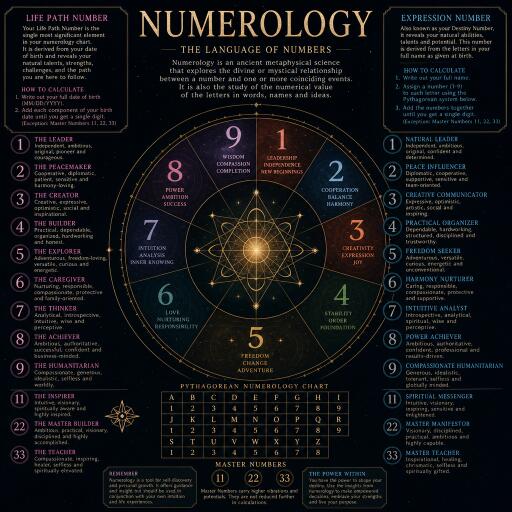
- Your Life Path (Core Rhythm): Add all the digits of your full birth date and reduce to a single digit (except master numbers 11, 22, or 33, if you honor them). This is your lifelong metronome—the way you naturally move through efforts and decisions.
- Your Personal Cycle (Seasonal Rhythm): The Personal Year, Month, and Day numbers change with the calendar and convey a shifting focus. They create “seasons” of energy inside which your week unfolds.
- Clock & Calendar (Daily Rhythm): Each day and hour can be reduced to digits, offering windows that harmonize with your core rhythm.
Here’s how to calculate the seasonal rhythm in brief:
- Personal Year: Add your birth month + birth day + the digits of the current year; reduce to 1–9. Example: born July 15 (7, 1+5) and year 2026 (2+0+2+6=10→1). First reduce birth month/day: 7+1+5=13→1+3=4. Then 4 + 1 = 5. Personal Year = 5.
- Personal Month: Personal Year + current month number (1–12), reduce to 1–9. Example: in June (6), 5 + 6 = 11 → 1+1 = 2.
- Personal Day: Personal Month + day of month, reduce to 1–9. Example: on the 12th, 2 + 12 = 14 → 1+4 = 5.
As days advance, your Personal Day number typically increments by 1 (cycling 1–9), creating a simple weekly arc you can anticipate and plan around.
The Nine Work Modes: What Each Number Does Best
Attach practical “modes” to the base numbers so you can match tasks to the day’s digits:
- 1 — Initiate: Begin, pitch, decide, take the first step.
- 2 — Collaborate: Pair up, negotiate, listen, nurture relationships.
- 3 — Create: Brainstorm, write, design, present playfully.
- 4 — Build: Systematize, draft processes, do focused, steady work.
- 5 — Explore: Network, iterate, test, travel, embrace change.
- 6 — Support: Serve clients, refine quality, tend home and team.
- 7 — Analyze: Research, reflect, study, plan quietly.
- 8 — Execute: Lead, negotiate resources, ship, measure impact.
- 9 — Complete: Close loops, publish, declutter, give back.
Step‑by‑Step: Build a Number‑Aligned Week
1) Choose Your Anchor
Pick one anchor number to emphasize for the next 1–4 weeks. For most people, the Life Path is a reliable anchor. If your Life Path is 7, for example, your week thrives on research blocks, quiet planning, and deep work.
2) Map Your Week’s Flow
Calculate your Personal Day for the first day of your week (e.g., Monday) and then increment by 1 for each subsequent day, looping 1–9. Now match the day’s major task bucket to its mode:
- On 1 days, schedule bold starts and decisions.
- On 3 days, prioritize ideation or content.
- On 4 days, build systems and finish drafts.
- On 9 days, clear the decks and hand off.
Let the Personal Day set the “headline” of the day; let your anchor number decide where your prime energy goes within that headline.
3) Find Resonant Windows by the Clock
Use the clock as a fine‑tuning dial:
- Resonant hours: Reduce the hour number to a single digit. Hour 7 and 16 (1+6=7) resonate with a Life Path 7. Hour 8 and 17 resonate with an 8, and so on.
- Resonant minutes: Start key blocks when the minute digits add to your target. For target 7, start at :16, :25, :34, :43, or :52. For target 3, start at :12, :21, :30, :03, etc.
- Compound resonance: If the day is a 4 and your anchor is 7, schedule your “anchor block” during an hour reduced to 7 and begin at a 7‑minute mark (:16, :25…). The rest of the day leans into 4‑mode tasks.
4) Assign Energy‑Fitting Tasks
Break your to‑do list into nine small piles by mode. For each day, pick from the pile that matches the Personal Day number for the bulk of your time. Then, add a single, non‑negotiable 60–120 minute block dedicated to your anchor number at a resonant hour. This gives structure (the day’s flow) plus identity (your anchor streak).
5) Close With a Micro‑Ritual
End each day with a 5‑minute ritual tied to the day’s number. Examples:
- On a 2 day, send two gratitude messages.
- On a 5 day, try a new route or read a page from an unfamiliar topic.
- On a 9 day, recycle or archive three old files.
Case Study: A Week in Practice
Meet Maya, born July 15, 1992. First, find her core rhythm:
- Life Path: 1+9+9+2+7+1+5 = 34 → 3+4 = 7. Anchor = 7.
Suppose it’s June. Compute seasonal rhythm:
- Personal Year (2026 example): Birth month/day 7+1+5=13→4. Year digits 2+0+2+6=10→1. 4+1=5. Personal Year = 5.
- Personal Month (June): 5 + 6 = 11 → 2.
- Personal Day: if Monday is the 10th, 2 + 10 = 12 → 3. Tuesday is 4, Wednesday is 5, and so on.
Now design the week:
- Monday (3 day): Morning brainstorm and outline for a presentation; anchor block at 16:25 (1+6=7; 2+5=7) for quiet slide editing and data checks.
- Tuesday (4 day): Process‑building and calendar hygiene; anchor block 07:34 for research time.
- Wednesday (5 day): Client calls and exploratory demos; anchor block 17:16 to read a new whitepaper.
- Thursday (6 day): Team support and quality reviews; anchor block 07:25 for literature notes.
- Friday (7 day): Full‑length deep work sprint during 07:00–09:00; meetings minimized.
- Saturday (8 day): Household leadership tasks (budgeting, big errands); anchor at 16:52 for reflective journaling on long‑term goals.
- Sunday (9 day): Declutter inbox and donate items; anchor at 07:43 for introspection and planning next week’s 7‑blocks.
Notice the interplay: the day’s number shapes the overall theme, while the 7‑anchor guarantees that Maya’s signature strength—focused learning and analysis—moves forward every single day during a resonant hour.
When Numbers Clash: Dissonance and How to Use It
Sometimes the calendar throws you a 5 day (explore) filled with 4‑type obligations (build). Or your anchor (7) doesn’t suit a high‑energy presentation slot. Instead of forcing alignment, try:
- Role‑splitting: Use the first 20 minutes to ease into the opposite mode. On a 5 day of structured tasks, begin by refreshing your system with a small experiment (like a new template) to satisfy 5 before settling into 4.
- Bridging tasks: Identify overlaps. A 7 anchor on an 8 day? Begin the leadership meeting with a quick data insight (7) that frames a decisive agenda (8).
- Timeboxing misfits: If you must perform against the day’s number, compress it: “I’ll do 45 minutes of 8‑mode admin now, then 60 minutes of 7‑anchor deep work.”
Beyond the Workday: Home, Health, and Creativity
- Home: Use 6 days for small acts of domestic care—cook, fix, or tidy for 20 minutes. Use 9 days to release: donate, recycle, archive.
- Health: 1 days favor starting a new habit; 4 days fit consistent routines; 5 days invite variety (new route, new exercise); 7 days suit reflective practices (meditation, reading).
- Creativity: 3 days for free ideation, 4 days to draft, 8 days to publish or sell, 9 days to share generously.
Measuring Alignment Without Magical Thinking
Chrono‑numerology isn’t about predicting outcomes; it’s a framework for attention. Keep it grounded:
- Track energy and flow: After your anchor block, rate focus and satisfaction from 1–5. Notice patterns across days and hours.
- Test changes: If 7‑blocks at 07:xx drag, try 16:xx the following week. Compare results honestly.
- Iterate light‑heartedly: Treat numbers as creative constraints, not commands. The point is rhythm, not rigidity.
Quick Reference: Matching Tasks to Your Numbers
- 1: Start something that matters. Make a decision you’ve delayed.
- 2: Have a 1:1, ask for feedback, harmonize a disagreement.
- 3: Draft, doodle, rehearse, make it fun and shareable.
- 4: Build a checklist, tidy your systems, grind with grace.
- 5: Try a new tool, meet someone new, ship a small experiment.
- 6: Improve quality, care for your space, support a colleague.
- 7: Research, read, reflect, design your strategy quietly.
- 8: Negotiate, lead a push, measure impact, make it real.
- 9: Finish, release, archive, and give something away.
Frequently Asked, Briefly Answered
Do I need to honor master numbers (11/22/33)? If they’re meaningful to you, you can. For scheduling, most people find single‑digit modes simpler. You can treat 11 as a high‑voltage 2, 22 as a masterful 4, 33 as an amplified 6.
What if my job isn’t flexible? Use resonant minutes to micro‑tune starts and finishes (:16, :25, :34, etc.) and reserve anchor blocks for early morning, lunch, or late afternoon.
Is this “real” or just symbolic? It’s symbolic. The value comes from focus, intention, and consistent review. If the rhythm elevates your clarity and steadiness, keep it. If it doesn’t, change it.
Try It This Week
Start small. Calculate your Life Path and this month’s Personal Day for Monday. Assign the day’s main mode, pick a single 60–120 minute anchor block at a resonant hour, and begin at a resonant minute. Score your focus afterward. Repeat for five workdays. By the end of the week, you’ll have data—not dogma—about how number rhythms can shape a calmer, more intentional schedule.
Chrono‑numerology doesn’t promise miracles. It offers cadence. In a world of noise, a gentle beat you can trust might be exactly what you need to move forward, one aligned hour at a time.